Evaluating the Factors Associated with Antenatal Care Attendance among Pregnant Women in Tertiary Healthcare settings
DOI:
https://doi.org/10.68041/anjmls.v1i3/05Keywords:
Health Services Accessibility, Maternal Health Services, Pregnancy, Prenatal Care, Social Support, Socioeconomic FactorsAbstract
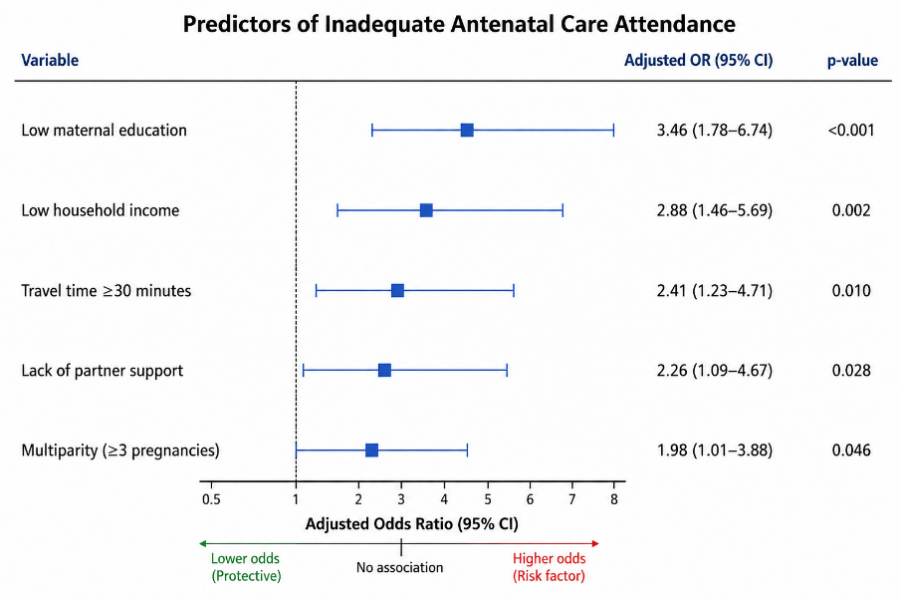
Background: ANC (Antenatal Care) services can help identify and manage early pregnancy risks and provide access to essential preventive and counseling services. The objective of this study was to evaluate ANC visit attendance, visit timing and quality, and factors associated with poor attendance among pregnant women. Method: This study comprised 210 pregnant women attending the antenatal clinic, who were interviewed using a structured questionnaire, which included items related to sociodemographic characteristics, obstetric history, household income, access to health services, partner's support, and ANC utilization. Data were analysed with SPSS version 26.0. Chi-square or Fisher's exact tests were used for the assessment of associations, subsequently analyzed by multivariable logistic regression. Results: Overall, 144 women (68.6%) attended four or more ANC visits, while 66 women (31.4%) attended fewer than four ANC visits. 128 women (61.0%) reported being registered for a first-trimester pregnancy. Financial limitations (28.8%) and out-of-the-way distance to the health facility (24.2%) were the most common obstacles reported. In multivariable analysis, low maternal education (AOR=3.46, 95% CI: 1.78–6.74; p<0.001), low household income (AOR=2.88, 95% CI: 1.46–5.69; p=0.002), travel time of at least 30 minutes (AOR=2.41, 95% CI: 1.23–4.71; p=0.010), lack of partner support (AOR=2.26, 95% CI: 1.09–4.67; p=0.028), and multiparity (AOR=1.98, 95% CI: 1.01–3.88; p=0.046) independently predicted inadequate attendance. Conclusion: Almost one-third of the participants did not attend the recommended minimum institutional visits for ANC. Enhanced maternal education, financial support, geographic access, and partner engagement can improve timely and sustained ANC attendance.References
1. Sidabungke MD, Anggraini L, Sulistyaningrum H, Wildan V, Sulfiah W. The importance of quality antenatal care in improving maternal and infant health. Int J Psychol Health Sci. 2025;3(4):562–570. https://doi.org/10.38035/ijphs.v3i4.1386 DOI: https://doi.org/10.38035/ijphs.v3i4.1386
2. Alipova G, Ablakimova N, Tussupkaliyeva K, Bermagambetova S, Kosmuratova S, Karimsakova B, et al. Prevention of pre-eclampsia: modern strategies and the role of early screening. J Clin Med. 2025;14(9):2970. https://doi.org/10.3390/jcm14092970 DOI: https://doi.org/10.3390/jcm14092970
3. Lee S, Adam E, Kanyike AM, Wani S, Kasibante S, Mukunya D, et al. Compliance with the WHO recommended 8+ antenatal care contacts schedule among postpartum mothers in eastern Uganda: a cross-sectional study. PLoS One. 2024;19(12):e0314769. https://doi.org/10.1371/journal.pone.0314769 DOI: https://doi.org/10.1371/journal.pone.0314769
4. Baten A, Biswas RK, Kendal E, Bhowmik J. Utilization of maternal healthcare services in low- and middle-income countries: a systematic review and meta-analysis. Syst Rev. 2025;14(1):88. https://doi.org/10.1186/s13643-025-02832-0 DOI: https://doi.org/10.1186/s13643-025-02832-0
5. Taha RY, Caesaria PR, Kurniawan F. Maternal healthcare service utilization in low- and middle-income countries: a systematic review and meta-analysis. Int J Contemp Sci. 2026;4(4):1297–1308. https://doi.org/10.55927/f20dsr36 DOI: https://doi.org/10.55927/f20dsr36
6. Ekholuenetale M, Benebo FO, Idebolo AF. Individual-, household-, and community-level factors associated with eight or more antenatal care contacts in Nigeria: evidence from Demographic and Health Survey. PLoS One. 2020;15(9):e0239855. https://doi.org/10.1371/journal.pone.0239855 DOI: https://doi.org/10.1371/journal.pone.0239855
7. Abdalla Osman Mohamed S, Mohamed GS, Attaelmanan Mahgoub AK, Ahmed F, Taha AB, Abbashar Abdelmahmoud EM, et al. Barriers to antenatal care attendance in developing countries: a systematic review. Cureus. 2025;17(10):e95342. https://doi.org/10.7759/cureus.95342 DOI: https://doi.org/10.7759/cureus.95342
8. He Z, Bishwajit G, Wu F. Sociodemographic determinants of reproductive healthcare service use among pregnant women in Pakistan. Healthcare (Basel). 2025;13(4):440. https://doi.org/10.3390/healthcare13040440 DOI: https://doi.org/10.3390/healthcare13040440
9. Rana MS, Mazumder S, Khan MT, Khan MM, Rahman MM. Trends and determinants of caesarean section in South Asian countries: Bangladesh, Nepal, and Pakistan. PLoS One. 2024;19(12):e0311082. https://doi.org/10.1371/journal.pone.0311082 DOI: https://doi.org/10.1371/journal.pone.0311082
10. Afridi JR, Jan SA, Asif MF. Assessing inequality of opportunity in access to maternal healthcare services in Pakistan: a quantitative attempt. BMC Health Serv Res. 2025;25(1):1167. https://doi.org/10.1186/s12913-025-13312-5 DOI: https://doi.org/10.1186/s12913-025-13312-5
11. Saad-Haddad G, DeJong J, Terreri N, Restrepo-Méndez MC, Perin J, Vaz L, et al. Patterns and determinants of antenatal care utilization: analysis of national survey data in seven Countdown countries. J Glob Health. 2016;6(1):010404. https://doi.org/10.7189/jogh.06.010404 DOI: https://doi.org/10.7189/jogh.06.010404
12. Sullivan KM, Dean A, Soe MM. OpenEpi: a web-based epidemiologic and statistical calculator for public health. Public Health Rep. 2009;124(3):471–474. https://doi.org/10.1177/003335490912400320 DOI: https://doi.org/10.1177/003335490912400320
13. Goodyear MD, Krleza-Jeric K, Lemmens T. The Declaration of Helsinki. BMJ. 2007;335(7621):624–625. https://doi.org/10.1136/bmj.39339.610000.BE DOI: https://doi.org/10.1136/bmj.39339.610000.BE
14. Haith-Cooper M, Payne D, Almas N, Rattray M, Iqbal H. Supporting cancer screening uptake in South Asian women: the Wise Up to Cancer public health intervention. Crit Public Health. 2025;35(1):2520406. https://doi.org/10.1080/09581596.2025.2520406 DOI: https://doi.org/10.1080/09581596.2025.2520406
15. Busch-Hallen J, Ayoub J, Harding KB, Raza S, Okonkwo O, Adebisi B, et al. Acceptability, adherence, and provision through antenatal care: evidence on multiple micronutrient supplementation in Pakistan and Nigeria. Nutrients. 2026;18(7):1101. https://doi.org/10.3390/nu18071101 DOI: https://doi.org/10.3390/nu18071101
16. Khan A, Hamid S, Reza TE, Hanif K, Emmanuel F. Assessment of effective coverage of antenatal care and associated factors in squatter settlements of Islamabad Capital Territory, Pakistan: an analytical cross-sectional study. Cureus. 2022;14(8):e28454. https://doi.org/10.7759/cureus.28454 DOI: https://doi.org/10.7759/cureus.28454
17. Aftab IB, Chakma T, Ahmed A, Haque SMR. Socioeconomic inequalities in access to maternal healthcare in South Asian countries: a systematic review. PLoS One. 2025;20(6):e0326130. https://doi.org/10.1371/journal.pone.0326130 DOI: https://doi.org/10.1371/journal.pone.0326130
18. Shahwar A, Jawad M, Abdullah MA, Haider A, Parveen L, Kanwal I, et al. Barriers to antenatal care utilization among rural women: a qualitative study from three villages in Jhelum District, Pakistan. Int J Biol Biomed Res. 2026;2(1):20–26. https://doi.org/10.54660/IJBBR.2026.2.1.20-26 DOI: https://doi.org/10.54660/IJBBR.2026.2.1.20-26
19. Talie E, Endeshaw D, Adal O, Tareke AA, Kebede N, Delie AM, et al. Determinants of antenatal care dropout among pregnant women in Africa: a systematic review and meta-analysis. Syst Rev. 2025;14(1):186. https://doi.org/10.1186/s13643-025-02906-z DOI: https://doi.org/10.1186/s13643-025-02906-z
20. Appiah-Kubi R, Iradukunda F, Perry M, Bazile W, Muwanga P, Roberts SC. Transportation barriers to prenatal care among Black/African Americans: a scoping review. Public Health Chall. 2025;4(4):e70128. https://doi.org/10.1002/puh2.70128 DOI: https://doi.org/10.1002/puh2.70128
21. Mihret MS, Alemu K, Beshah DT, Gezie LD, Erlandsson K, Lindgren H. Looking into opportunities for maternity continuum of care improvement within the primary health care system in Northwest Ethiopia: primary health care-oriented research. BMC Health Serv Res. 2025;25(1):518. https://doi.org/10.1186/s12913-025-12688-8 DOI: https://doi.org/10.1186/s12913-025-12688-8
22. Tengera O, Meharry P, Nkurunziza A, Babenko-Mould Y, Rugema J, Rulisa S, et al. Barriers hindering attendance and adherence to antenatal care visits among women in rural areas in Rwanda: an exploratory qualitative study. PLoS One. 2025;20(5):e0323762. https://doi.org/10.1371/journal.pone.0323762 DOI: https://doi.org/10.1371/journal.pone.0323762
23. Schmidt CN, Butrick E, Musange S, Mulindahabi N, Walker D. Towards stronger antenatal care: understanding predictors of late presentation to antenatal services and implications for obstetric risk management in Rwanda. PLoS One. 2021;16(8):e0256415. https://doi.org/10.1371/journal.pone.0256415 DOI: https://doi.org/10.1371/journal.pone.0256415
24. Dewidar O, John J, Baqar A, Madani MT, Saad A, Riddle A, et al. Effectiveness of nutrition counseling for pregnant women in low- and middle-income countries to improve maternal and infant behavioral, nutritional, and health outcomes: a systematic review. Campbell Syst Rev. 2023;19(4):e1361. https://doi.org/10.1002/cl2.1361 DOI: https://doi.org/10.1002/cl2.1361
Published
Issue
Section
License
Copyright (c) 2026 Muneera Ehsan, Komal Anayat, Shazia Ahmed, Fatima Mubeen Ali

This work is licensed under a Creative Commons Attribution-NonCommercial 4.0 International License.
Al-Najam Journal of Medical and Life Sciences (ANJMLS) follows the Attribution Creative Commons-Non commercial (CC BY-NC) license which allows the users to copy and redistribute the material in any medium or format, remix, transform and build upon the material. The users must give credit to the source and indicate, provide a link to the license, and indicate if changes were made. However, the CC BY-NC license restricts the use of material for commercial purposes (Further details are available at website. The Editorial Board of the ANJMLS endeavors to ensure the accuracy, integrity, and quality of all published content. However, the responsibility of opinions, interpretations, and conclusions expressed in the published articles rests entirely with the authors and do not necessarily reflect the views of the Editorial Board, publisher, or affiliated institutions.