Knowledge of Medication Management and Therapeutic Care Practices Among Nurses Caring for Older Adults: A Cross-Sectional Study
DOI:
https://doi.org/10.68041/anjmls.v1i2/05Keywords:
Medication Management, , Therapeutic Care, Nurses, Polypharmacy, Geriatric Nursing, Patient SafetyAbstract
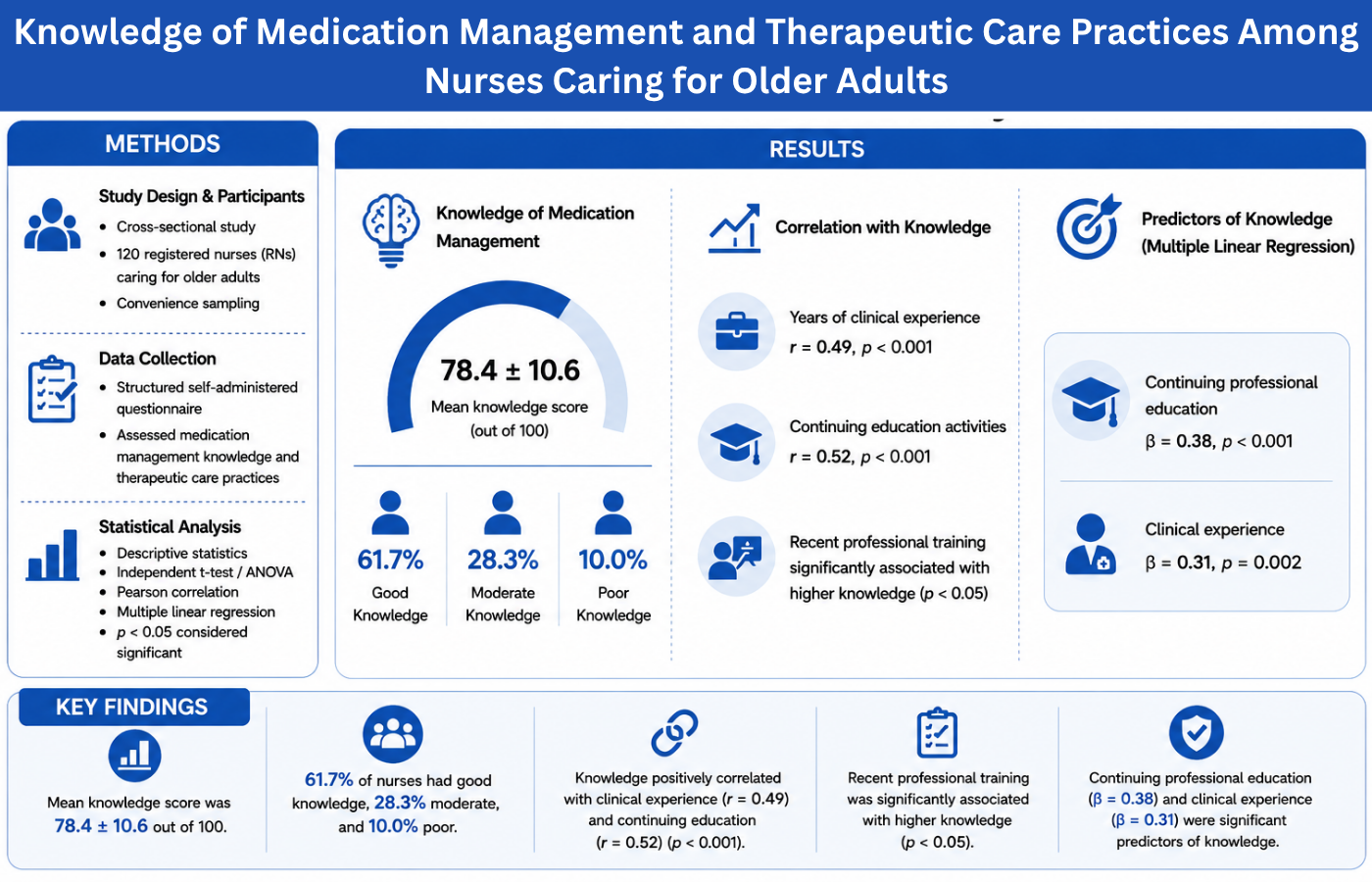
Background: Older people often have several chronic diseases, and they need to take multiple medications and undergo ongoing therapy. The purposes of this study were to determine the knowledge of medication management and therapeutic care practices among caregivers (nurses) of older adults and to explore factors associated with the level of knowledge. Methods: A cross-sectional study design (n=120) via convenience sampling technique used a structured self-administered questionnaire to evaluate knowledge about medication administration, drug interactions, adverse drug reactions, managing polypharmacy, therapeutic monitoring and educating patients. Data were analyzed using SPSS version 26.0 with p-value < 0.05 as statistically significant. Results: The overall mean score of their knowledge was 78.4 ± 10.6 out of 100. It was observed that the majority of the nurses (61.7%) had good knowledge, 28.3 % had moderate knowledge, and 10.0% had poor knowledge. A significant correlation was found between knowledge and some factors, such as higher scores with increasing clinical experience and higher scores with those who had recently completed professional training (p< 0.05). There were positive relationships between knowledge and years of experience (r = 0.49, p < 0.001) as well as between knowledge and attendance in continuing education activities (r = 0.52, p < 0.001). Multiple regression analysis showed that continuing professional education (β = 0.38, p < 0.001) and clinical experience (β = 0.31, p = 0.002) were significant factors related to knowledge about medication management and therapeutic care practices. Conclusion: The majority of nurses showed evidence of good knowledge of medication management and therapeutic practices for older people. There was a significant contribution to higher knowledge level from professional training and clinical experience.
References
1. Lammila-Escalera E, Greenfield G, Aldakhil R, Zaman H, Neves AL, Majeed A, et al. Structured medication reviews for adults with multimorbidity and polypharmacy in primary care: a systematic review protocol. BMJ Open. 2024; 14(5). https://doi.org/10.1136/bmjopen-2023-082825 DOI: https://doi.org/10.1136/bmjopen-2023-082825
2. Pazan F, Wehling M. Polypharmacy in older adults: a narrative review of definitions, epidemiology and clinical consequences. Eur Geriatr Med. 2021; 12(3):443–452. https://doi.org/10.1007/s41999-021-00479-3 DOI: https://doi.org/10.1007/s41999-021-00479-3
3. Ngcobo NN. Influence of ageing on the pharmacodynamics and pharmacokinetics of chronically administered medicines in geriatric patients: a review. Clin Pharmacokinet. 2025; 64(3):335–367. https://doi.org/10.1007/s40262-024-01466-0 DOI: https://doi.org/10.1007/s40262-025-01494-4
4. Zazzara MB, Palmer K, Vetrano DL, Carfì A, Onder G. Adverse drug reactions in older adults: a narrative review of the literature. Eur Geriatr Med. 2021; 12(3):463–473. https://doi.org/10.1007/s41999-021-00481-9 DOI: https://doi.org/10.1007/s41999-021-00481-9
5. Hagiwara S, Komiyama J, Iwagami M, Hamada S, Komuro M, Kobayashi H, et al. Polypharmacy and potentially inappropriate medications in older adults who use long-term care services: a cross-sectional study. BMC Geriatr. 2024; 24(1):730. https://doi.org/10.1186/s12877-024-05296-4 DOI: https://doi.org/10.1186/s12877-024-05296-4
6. Ghezeljeh TN, Kohne AM, Farahani MA, Rafii F, Shahrestanaki SK, Asgari P, et al. Home healthcare medication safety risks among older adults with chronic diseases: a qualitative study. BMC Nurs. 2025;24(1):73. https://doi.org/10.1186/s12912-024-02675-5 DOI: https://doi.org/10.1186/s12912-024-02675-5
7. Rosengren K, Szemberg C. Ensuring safe medication assessment for older adults: a pilot study. Home Health Care Manag Pract. 2025;37(2):139–146. https://doi.org/10.1177/10848223241257498 DOI: https://doi.org/10.1177/10848223241257498
8. Vaismoradi M, Lillo Crespo M, Turjamaa R. Nurse-led medication management for older people in home care: a systematic review of evolving nurse responsibilities in technology-assisted care. Home Health Care Manag Pract. 2025;37(2):140–153. https://doi.org/10.1177/10848223241283415 DOI: https://doi.org/10.1177/10848223241283415
9. Berardinelli D, Paoletti G, Sarli L, Artioli G, Marmo G, Aceti T, et al. Nurse-led interventions for improving medication adherence in adults with chronic diseases: a systematic review. Healthcare (Basel). 2024;12(23):2337. https://doi.org/10.3390/healthcare12232337 DOI: https://doi.org/10.3390/healthcare12232337
10. Zhang P, Xu R, Cao S, Mo L, Liu Y, Gao C, et al. Relationship between critical thinking ability and medication safety competence among clinical nurses: a multicenter cross-sectional study. J Clin Nurs. 2025;34(6):2107–2116. https://doi.org/10.1111/jocn.17361 DOI: https://doi.org/10.1111/jocn.17361
11. Kim HR, Kim YH. Influence of nursing work environment and nursing professionalism on medication safety competence among nurses in general hospitals. J Fundam Nurs Sci. 2026;33(1):72–82. https://doi.org/10.7739/jkafn.2026.33.1.72
12. Jung S, Park J. Educational needs for medication safety competence among nurses by clinical ladder stage. PLoS One. 2025;20(4). https://doi.org/10.1371/journal.pone.0319483 DOI: https://doi.org/10.1371/journal.pone.0319483
13. Chu AMY, So HY, Yu LWL, Ho BPY, Chang SSY, Chan LSH, et al. Nurses’ knowledge, attitudes, and role perception in medication administration: do hospital context and nurses’ level of professional experience make a difference? BMC Nurs. 2026;25(1):37. https://doi.org/10.1186/s12912-025-04110-9 DOI: https://doi.org/10.1186/s12912-025-04110-9
14. Alandajani A, Khalid B, Ng YG, Banakhar M. Knowledge and attitudes regarding medication errors among nurses: a cross-sectional study in major Jeddah hospitals. Nurs Rep. 2022;12(4):1023–1039. https://doi.org/10.3390/nursrep12040098 DOI: https://doi.org/10.3390/nursrep12040098
15. Coelho F, Furtado L, Mendonça N, Soares H, Duarte H, Costeira C, et al. Predisposing factors to medication errors by nurses and prevention strategies: a scoping review of recent literature. Nurs Rep. 2024;14(3):1553–1569. https://doi.org/10.3390/nursrep14030117
16. Cheng C, Yu H, Wang Q. Nurses’ experiences concerning older adults with polypharmacy: a meta-synthesis of qualitative findings. Healthcare (Basel). 2023;11(3):334. https://doi.org/10.3390/healthcare11030334 DOI: https://doi.org/10.3390/healthcare11030334
17. Engels L, van den Akker M, Denig P, Stoffers H, Gerger H, Bohnen J, et al. Medication management in patients with polypharmacy in primary care: a scoping review of clinical practice guidelines. J Evid Based Med. 2025;18(1). https://doi.org/10.1111/jebm.70015 DOI: https://doi.org/10.1111/jebm.70015
18. Han Y, Chen J, Xu Y, Huang P, Hou L. Nurse-led medication management as a critical component of transitional care for preventing drug-related problems. Aging Clin Exp Res. 2024;36(1):151. https://doi.org/10.1007/s40520-024-02799-3 DOI: https://doi.org/10.1007/s40520-024-02799-3
19. Yu HY, Huang CH, Shen YC, Lin HL, Chang LC. Factors associated with continuing education needs in medication administration among school nurses. J Adv Nurs. 2024;80(5):1882–1890. https://doi.org/10.1111/jan.15967 DOI: https://doi.org/10.1111/jan.15967
20. Myroniak K, Elder S. Improving safe medication administration in new RNs using simulation. J Contin Educ Nurs. 2021;52(1):30–33. https://doi.org/10.3928/00220124-20201215-08 DOI: https://doi.org/10.3928/00220124-20201215-08
21. Eze AU, Marufu TC, Amagyei A, Nelson D, Laparidou D, Manning JC. Assessing the effectiveness of interventions implemented by nurses to reduce medication administration errors in hospitalised acute adult patient settings: systematic review and meta-analysis. J Clin Nurs. 2026;35(3):1104–1124. https://doi.org/10.1111/jocn.70109 DOI: https://doi.org/10.1111/jocn.70109
22. Oh JA, Kim EA, Kim HR. Influence of critical thinking disposition, clinical reasoning competence, and nursing practice environment on medication safety competence of hospital nurses. Healthcare (Basel). 2025;13(5):542. https://doi.org/10.3390/healthcare13050542 DOI: https://doi.org/10.3390/healthcare13050542
23. Zhang P, Xu R, Cao S, Mo L, Liu Y, Gao C, et al. Factors associated with medication safety competence among clinical nurses in China: a latent profile analysis. J Nurs Res. 2026;34(3). https://doi.org/10.1097/jnr.0000000000000749 DOI: https://doi.org/10.1097/jnr.0000000000000749
24. Mohebi Z, Bijani M, Dehghan A. Investigating safe nursing care and medication safety competence in nursing students: a multicenter cross-sectional study in Iran. BMC Nurs. 2024;23(1):13. https://doi.org/10.1186/s12912-023-01684-0 DOI: https://doi.org/10.1186/s12912-023-01684-0
25. Coelho F, Furtado L, Mendonça N, Soares H, Duarte H, Costeira C, et al. Predisposing factors to medication errors by nurses and prevention strategies: a scoping review of recent literature. Nurs Rep. 2024;14(3):1553–1569. https://doi.org/10.3390/nursrep14030117 DOI: https://doi.org/10.3390/nursrep14030117
26. Kim HR, Kim YH. Influence of nursing work environment and nursing professionalism on medication safety competence among nurses in general hospitals. J Fundam Nurs Sci. 2026;33(1):72–82. https://doi.org/10.7739/jkafn.2026.33.1.72 DOI: https://doi.org/10.7739/jkafn.2026.33.1.72
27. Chang A, Lee Y, Kang M, Lee JY. The relationship of medication safety competence, second victim experiences, second victim support, and negative work outcomes among clinical nurses. J Korean Acad Nurs Adm. 2025;31(5):493–503. https://doi.org/10.11111/jkana.2025.0009 DOI: https://doi.org/10.11111/jkana.2025.0009
Published
Issue
Section
License
Copyright (c) 2026 Naila Anjum, Sadia Mukarram, Nimra Rehman (Author)

This work is licensed under a Creative Commons Attribution-NonCommercial 4.0 International License.
Al-Najam Journal of Medical and Life Sciences (ANJMLS) follows the Attribution Creative Commons-Non commercial (CC BY-NC) license which allows the users to copy and redistribute the material in any medium or format, remix, transform and build upon the material. The users must give credit to the source and indicate, provide a link to the license, and indicate if changes were made. However, the CC BY-NC license restricts the use of material for commercial purposes (Further details are available at website. The Editorial Board of the ANJMLS endeavors to ensure the accuracy, integrity, and quality of all published content. However, the responsibility of opinions, interpretations, and conclusions expressed in the published articles rests entirely with the authors and do not necessarily reflect the views of the Editorial Board, publisher, or affiliated institutions.