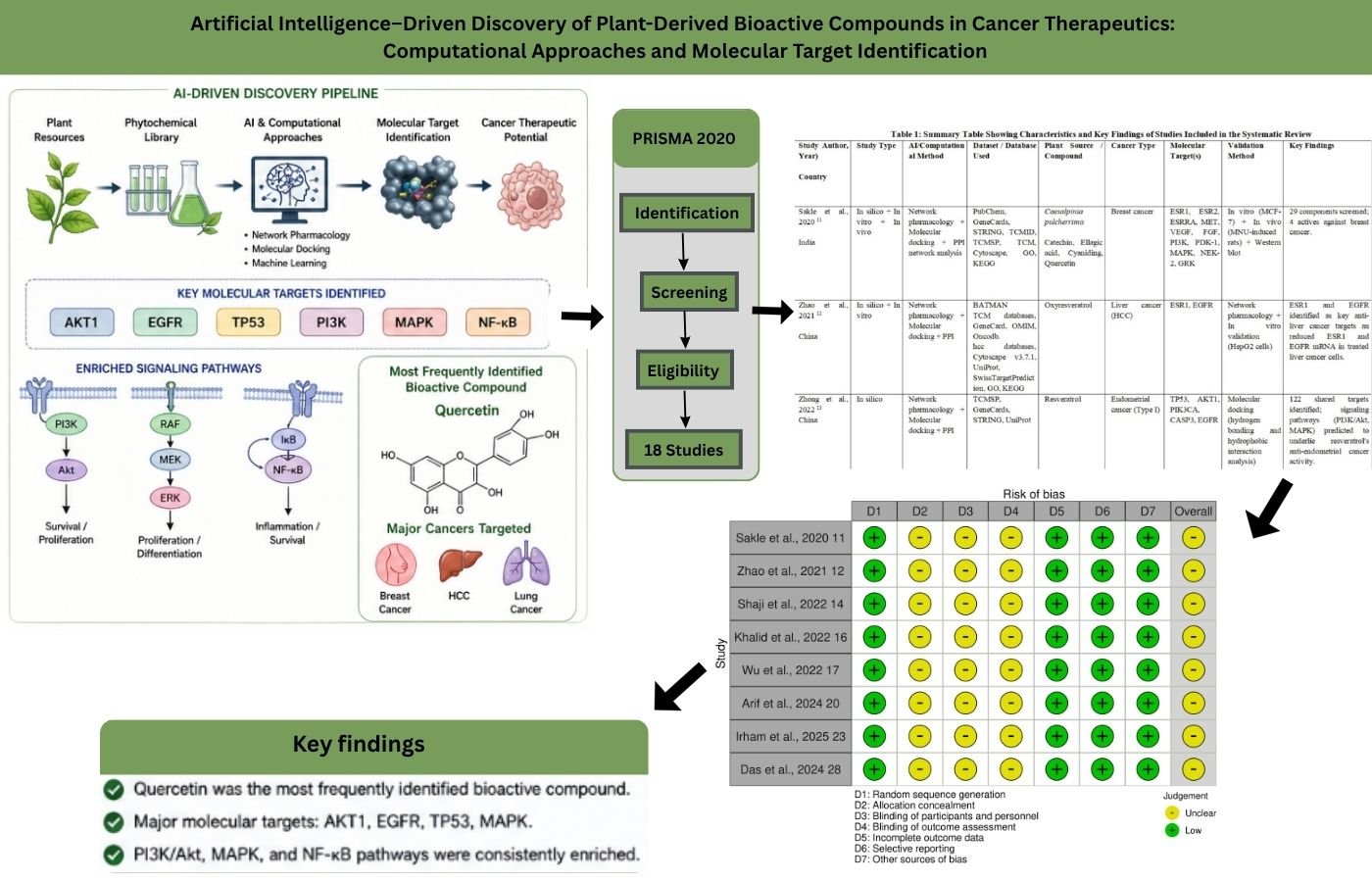
Artificial Intelligence–Driven Discovery of Plant-Derived Bioactive Compounds in Cancer Therapeutics: Computational Approaches and Molecular Target Identification
DOI:
https://doi.org/10.68041/anjmls.v1i3/07Keywords:
Artificial Intelligence, Computational Biology, Drug Discovery, Molecular Docking Simulation, Neoplasms, Phytochemicals, Plants, MedicinalAbstract
Objective: Artificial intelligence (AI) use and computational approaches have transformed the discovery of plant-derived bioactive chemicals for cancer treatment. This review synthesized evidence on AI-based approaches, including network pharmacology, molecular docking, and machine learning, for identifying and validating anticancer plant-derived phytochemicals, focusing on their molecular targets and signaling pathways. Data Sources: PRISMA 2020 guidelines were followed. PubMed, Scopus, Web of Science, and Google Scholar were searched between October 2020 and July 2025. Study Selection: Studies with at least one AI or computational method, investigating plant-derived phytochemicals for anticancer effects, reporting quantitative computational outcomes, and offering free full-text access in English were included. Review articles, conference abstracts, non-plant studies, and non-English publications were excluded. Data Extraction: Two reviewers extracted data on predefined variables. An adapted PROBAST tool was used to assess risk of bias for in silico studies and modified SYRCLE tools for in vitro and in vivo studies, with certainty of evidence evaluated using the GRADE method. Data Synthesis: Eighteen studies satisfied the inclusion criteria. The most frequently discovered bioactive chemical was quercetin, which targets breast cancer, hepatocellular carcinoma (HCC), and lung cancer via AKT1, EGFR, TP53, and MAPK signaling pathways. The majority of in silico studies have a high risk of bias, while in vitro and in vivo studies were rated as having some concerns. The overall certainty of evidence was low. Conclusion: AI-based computational techniques have become critical tools for discovering plant-derived compounds and identifying multi-target mechanisms involving AKT1, EGFR, and PI3K/Akt signaling.References
1. Sung H, Ferlay J, Siegel RL, Laversanne M, Soerjomataram I, Jemal A, et al. Global Cancer Statistics 2020: GLOBOCAN Estimates of Incidence and Mortality Worldwide for 36 Cancers in 185 Countries. CA Cancer J Clin. 2021;71(3):209–249. https://doi.org/10.3322/caac.21660 DOI: https://doi.org/10.3322/caac.21660
2. Newman DJ, Cragg GM. Natural Products as Sources of New Drugs over the Nearly Four Decades from 01/1981 to 09/2019. J Nat Prod. 2020;83(3):770–803. https://dx.doi.org/10.1021/acs.jnatprod.9b01285 DOI: https://doi.org/10.1021/acs.jnatprod.9b01285
3. Asma ST, Acaroz U, Imre K, Morar A, Shah SR, Hussain SZ, et al. Natural products/bioactive compounds as a source of anticancer drugs. Cancers. 2022;14(24):6203. https://doi.org/10.3390/cancers14246203 DOI: https://doi.org/10.3390/cancers14246203
4. Kopustinskiene DM, Jakstas V, Savickas A, Bernatoniene J. Flavonoids as anticancer agents. Nutrients. 2020;12(2):457. https://doi.org/10.3390/nu12020457 DOI: https://doi.org/10.3390/nu12020457
5. Sadybekov AV, Katritch V. Computational approaches streamlining drug discovery. Nature. 2023;616(7958):673–685. https://doi.org/10.1038/s41586-023-05905-z DOI: https://doi.org/10.1038/s41586-023-05905-z
6. Tropsha A, Isayev O, Varnek A, Schneider G, Cherkasov A. Integrating QSAR modelling and deep learning in drug discovery: the emergence of deep QSAR. Nat Rev Drug Discov. 2024;23(2):141-55. https://doi.org/10.1038/s41573-023-00832-0 DOI: https://doi.org/10.1038/s41573-023-00832-0
7. Ru J, Li P, Wang J, Zhou W, Li B, Huang C, et al. TCMSP: a database of systems pharmacology for drug discovery from herbal medicines. J Cheminformatics. 2014;6(1):13. https://doi.org/10.1186/1758-2946-6-13 DOI: https://doi.org/10.1186/1758-2946-6-13
8. Nogales C, Mamdouh ZM, List M, Kiel C, Casas AI, Schmidt HH. Network pharmacology: curing causal mechanisms instead of treating symptoms. Trends Pharmacol Sci. 2022;43(2):136-150. https://doi.org/10.1016/j.tips.2021.11.004 DOI: https://doi.org/10.1016/j.tips.2021.11.004
9. Page MJ, McKenzie JE, Bossuyt PM, Boutron I, Hoffmann TC, Mulrow CD, et al. The PRISMA 2020 statement: an updated guideline for reporting systematic reviews. BMJ. 2021;372. https://doi.org/10.1136/bmj.n71 DOI: https://doi.org/10.1136/bmj.n71
10. Gao J, Yao Y, Xue J, Chen R, Yang X, Xu J, et al. Methodological conduct and risk of bias in studies on prenatal birthweight prediction models using machine learning techniques: a systematic review. BMC Pregnancy and Childbirth. 2025 Jul 2;25(1):696. https://doi.org/10.1186/s12884-025-07727-5 DOI: https://doi.org/10.1186/s12884-025-07727-5
11. Sakle NS, More SA, Mokale SN. A network pharmacology-based approach to explore potential targets of Caesalpinia pulcherima: an updated prototype in drug discovery. Sci Rep. 2020;10(1):17217. https://doi.org/10.1038/s41598-020-74251-1 DOI: https://doi.org/10.1038/s41598-020-74251-1
12. Zhao F, Qin J, Liang Y, Zhou R. Exploring anti-liver cancer targets and mechanisms of oxyresveratrol: in silico and verified findings. Bioengineered. 2021;12(2):9939–9948. https://doi.org/10.1080/21655979.2021.1985328 DOI: https://doi.org/10.1080/21655979.2021.1985328
13. Zhong Z, Guo X, Zheng Y. Network pharmacology-based and molecular docking analysis of resveratrol's pharmacological effects on type I endometrial cancer. Anticancer Agents Med Chem. 2022;22(10):1933–1944. https://doi.org/10.2174/1871520621666211015140455 DOI: https://doi.org/10.2174/1871520621666211015140455
14. Shaji SK, Drishya G, Sunilkumar D, Suravajhala P, Kumar GB, Nair BG. Systematic understanding of anti-tumor mechanisms of tamarixetin through network and experimental analyses. Sci Rep. 2022;12(1):3966. https://doi.org/10.1038/s41598-022-07087-6 DOI: https://doi.org/10.1038/s41598-022-07087-6
15. Huang X, Rehman HM, Szöllősi AG, Zhou S. Network pharmacology-based approach combined with bioinformatic analytics to elucidate the potential of curcumol against hepatocellular carcinoma. Genes. 2022;13(4):653. https://doi.org/10.3390/genes13040653 DOI: https://doi.org/10.3390/genes13040653
16. Khalid HR, Aamir M, Tabassum S, Alghamdi YS, Alzamami A, Ashfaq UA. Integrated system pharmacology approaches to elucidate multi-target mechanism of Solanum surattense against hepatocellular carcinoma. Molecules. 2022;27(19):6220. https://doi.org/10.3390/molecules27196220 DOI: https://doi.org/10.3390/molecules27196220
17. Wu Z, Kang J, Tan W, Wei C, He L, Jiang X, et al. In silico and in vitro studies on the mechanisms of Chinese medicine formula (Yiqi Jianpi Jiedu formula) in the treatment of hepatocellular carcinoma. Comput Math Methods Med. 2022;2022(1):8669993. https://doi.org/10.1155/2022/8669993 DOI: https://doi.org/10.1155/2022/8669993
18. Bultum LE, Tolossa GB, Kim G, Kwon O, Lee D. In silico activity and ADMET profiling of phytochemicals from Ethiopian indigenous aloes using pharmacophore models. Sci Rep. 2022;12(1):22221. https://doi.org/10.1038/s41598-022-26446-x DOI: https://doi.org/10.1038/s41598-022-26446-x
19. Bhattacharya K, Nath BC, Ahmed E, Khanal P, Chanu NR, Deka S, et al. Integration of network pharmacology, molecular docking, and simulations to evaluate phytochemicals from Phyllanthus sp. against cervical cancer. RSC Adv. 2024;14(6):4188–4200. https://doi.org/10.1039/d3ra06297j DOI: https://doi.org/10.1039/D3RA06297J
20. Arif R, Bukhari SA, Mustafa G, Ahmed S, Albeshr MF. Network pharmacology and experimental validation to explore the potential mechanism of Moringa oleifera for the treatment of breast cancer. Pharmaceuticals (Basel). 2024;17(5):617. https://doi.org/10.3390/ph17050617 DOI: https://doi.org/10.3390/ph17050617
21. Varadharajan V, Balu AK, Shiju A, Muthuramalingam P, Shin H, Venkidasamy B, et al. Deciphering the anticancer arsenal of Piper longum: network pharmacology and molecular docking unveil phytochemical targets against lung cancer. Int J Med Sci. 2024;21(10):1915. https://doi.org/10.7150/ijms.98393 DOI: https://doi.org/10.7150/ijms.98393
22. Saini H, Gupta PK, Mahapatra AK, Rajagopala S, Tripathi R, Nesari T. Deciphering the multi-scale mechanism of herbal phytoconstituents in targeting breast cancer: a computational pharmacological perspective. Sci Rep. 2024;14(1):23795. https://doi.org/10.1038/s41598-024-75059-z DOI: https://doi.org/10.1038/s41598-024-75059-z
23. Irham LM, Adikusuma W, Illian DN, Mazaya M, Mubaraq A, Ma’ruf M, et al. Deciphering anti-colorectal cancer potential of Avicennia alba bioactives via network pharmacology and in vitro validation. Sci Rep. 2025;15(1):27976. https://doi.org/10.1038/s41598-025-12500-x DOI: https://doi.org/10.1038/s41598-025-12500-x
24. Gao K, Chen Z, Zhang N, Jiang P. High throughput virtual screening and validation of plant-based EGFR L858R kinase inhibitors against non-small cell lung cancer: An integrated approach utilizing GC–MS, network pharmacology, docking, and molecular dynamics. Saudi Pharm J. 2024;32(9):102139. https://doi.org/10.1016/j.jsps.2024.102139 DOI: https://doi.org/10.1016/j.jsps.2024.102139
25. Gondokesumo ME, Rasyak MR. In-silico prediction of anti-breast cancer activity of ginger (Zingiber officinale) using machine learning techniques. Breast Dis. 2024;43(1):99-110. https://doi.org/10.3233/BD-249002 DOI: https://doi.org/10.3233/BD-249002
26. Grijaldo SJ, Alvarez MR, Heralde III FM, Nacario RC, Lebrilla CB, Rabajante JF, et al. Integrating Computational Methods in Network Pharmacology and In Silico Screening to Uncover Multi-targeting Phytochemicals against Aberrant Protein Glycosylation in Lung Cancer. ACS Omega. 2023;8(26):23833-23844. https://doi.org/10.1021/acsomega.3c01825 DOI: https://doi.org/10.1021/acsomega.2c07542
27. Quintal Bojórquez ND, Morales Mendoza LF, Hidalgo-Figueroa S, Hernández Álvarez AJ, Segura Campos MR. In silico analysis of the interaction of de novo peptides derived from Salvia hispanica with anticancer targets: Evaluation of the anticancer potential of de novo peptides derived from Salvia hispanica through molecular docking. J Biomol Struct Dyn. 2024;42(12):6119-6135. https://doi.org/10.1080/07391102.2023.2232045 DOI: https://doi.org/10.1080/07391102.2023.2232045
28. Das AP, Mathur P, Agarwal SM. Machine learning, molecular docking, and dynamics-based computational identification of potential inhibitors against lung cancer. ACS Omega. 2024;9(4):4528-39. https://doi.org/10.1021/acsomega.3c07338 DOI: https://doi.org/10.1021/acsomega.3c07338
29. Yang J, Gu J, Shen Y, Cao L, Zhou H, Zhu W. Effect of Shan Zha (Hawthorn or Crataegus) on gastrointestinal cancer: a network pharmacology and molecular docking study. Cancer Pathog Ther. 2023;1(4):229–237. https://doi.org/10.1016/j.cpt.2023.02.001 DOI: https://doi.org/10.1016/j.cpt.2023.02.001
30. Morgos DT, Stefani C, Miricescu D, Greabu M, Stanciu S, Nica S, et al. Targeting PI3K/AKT/mTOR and MAPK signaling pathways in gastric cancer. Int J Mol Sci. 2024;25(3):1848. https://doi.org/10.3390/ijms25031848 DOI: https://doi.org/10.3390/ijms25031848
31. Zenjanab MK, Hashemzadeh N, Alimohammadvand S, Sharifi-Azad M, Abdolahinia ED, Jahanban-Esfahlan R. Notch signaling suppression by golden phytochemicals: potential for cancer therapy. Adv Pharm Bull. 2024;14(2):302. https://doi.org/10.34172/apb.2024.035 DOI: https://doi.org/10.34172/apb.2024.035
32. Shahani SB, Shaikh P, Memon SG, Memon S. Possible prevention of reactive oxygen species induced human trabecular meshwork cell damage by resveratrol and ascorbic acid. Prof Med J. 2019;26(7):1036–41. https://doi.org/10.29309/TPMJ/2019.26.07.3229 DOI: https://doi.org/10.29309/TPMJ/2019.26.07.3229
33. Chen Y, Tan X, Zhang W, Li Y, Deng X, Zeng J, et al. Natural products targeting macroautophagy signaling in hepatocellular carcinoma therapy: recent evidence and perspectives. Phytother Res. 2024;38(3):1623–1650. https://doi.org/10.1002/ptr.8103 DOI: https://doi.org/10.1002/ptr.8103
34. Khaliq M, Aftab K, Ikhlaq A, Ahmed A. Drug Repurposing Potential of Natural Products: Molecular Targets, Pharmacological Profiles, and Precision Therapeutic Strategies: A Narrative Review. J Biomol Pathog Ther. 2026;2(3):156-162. https://doi.org/10.68041/jbpt.v2i3/09 DOI: https://doi.org/10.68041/jbpt.v2i3/09
35. Radwan AA, Alanazi F, Al-Dhfyan A. Bioinformatics-driven discovery of novel EGFR kinase inhibitors as anti-cancer therapeutics: in silico screening and in vitro evaluation. PLoS One. 2024;19(4). https://doi.org/10.1371/journal.pone.0298326 DOI: https://doi.org/10.1371/journal.pone.0298326
36. Gul F, Memon S, Ujjan I, Goswami P, Bhatti KA. The effects of 4β-hydroxy withanolide E extracted from Physalis Peruviana on Complete Blood Count of Dimethylbenz(a)anthracene-induced Breast Cancer in Albino Rats. Adv Life Sci. 2023;10(3):434–8. https://doi.org/10.62940/als.v10i3.1861 DOI: https://doi.org/10.62940/als.v10i3.1861
37. Xie X, Gui L, Qiao B, Wang G, Huang S, Zhao Y, et al. Deep learning in template-free de novo biosynthetic pathway design of natural products. Brief Bioinform. 2024;25(6). https://doi.org/10.1093/bib/bbae495 DOI: https://doi.org/10.1093/bib/bbae495
38. Iweala EJ, Oluwapelumi AE, Dania OE, Ugbogu EA. Bioactive phytoconstituents and their therapeutic potentials in the treatment of haematological cancers: a review. Life (Basel). 2023;13(7):1422. https://doi.org/10.3390/life13071422 DOI: https://doi.org/10.3390/life13071422
39. Dixit N, Motwani H, Patel SK, Rawal RM, Solanki HA. Decoding the mechanism of andrographolide to combat hepatocellular carcinoma: a network pharmacology integrated molecular docking and dynamics approach. J Biomol Struct Dyn. 2024;42(19):10237-55. https://doi.org/10.1080/07391102.2023.2256866 DOI: https://doi.org/10.1080/07391102.2023.2256866
Published
Issue
Section
License
Copyright (c) 2026 Irshad Khan, Asad Khalid, Mujtaba Ehsan, Muhammad Akram, Ejaz Ehsan Khan, Khaleeq Ullah

This work is licensed under a Creative Commons Attribution-NonCommercial 4.0 International License.
Al-Najam Journal of Medical and Life Sciences (ANJMLS) follows the Attribution Creative Commons-Non commercial (CC BY-NC) license which allows the users to copy and redistribute the material in any medium or format, remix, transform and build upon the material. The users must give credit to the source and indicate, provide a link to the license, and indicate if changes were made. However, the CC BY-NC license restricts the use of material for commercial purposes (Further details are available at website. The Editorial Board of the ANJMLS endeavors to ensure the accuracy, integrity, and quality of all published content. However, the responsibility of opinions, interpretations, and conclusions expressed in the published articles rests entirely with the authors and do not necessarily reflect the views of the Editorial Board, publisher, or affiliated institutions.