Prevalence and Concentration of Microplastics in Human Biological Matrices: A Systematic Review and Meta-Analysis
DOI:
https://doi.org/10.68041/anjmls.v1i2/07Keywords:
Biological Monitoring, Cross-Sectional Studies, Environmental Exposure, Environmental Pollutants, Epidemiology, Particulate Matter, Plastics, HumansAbstract
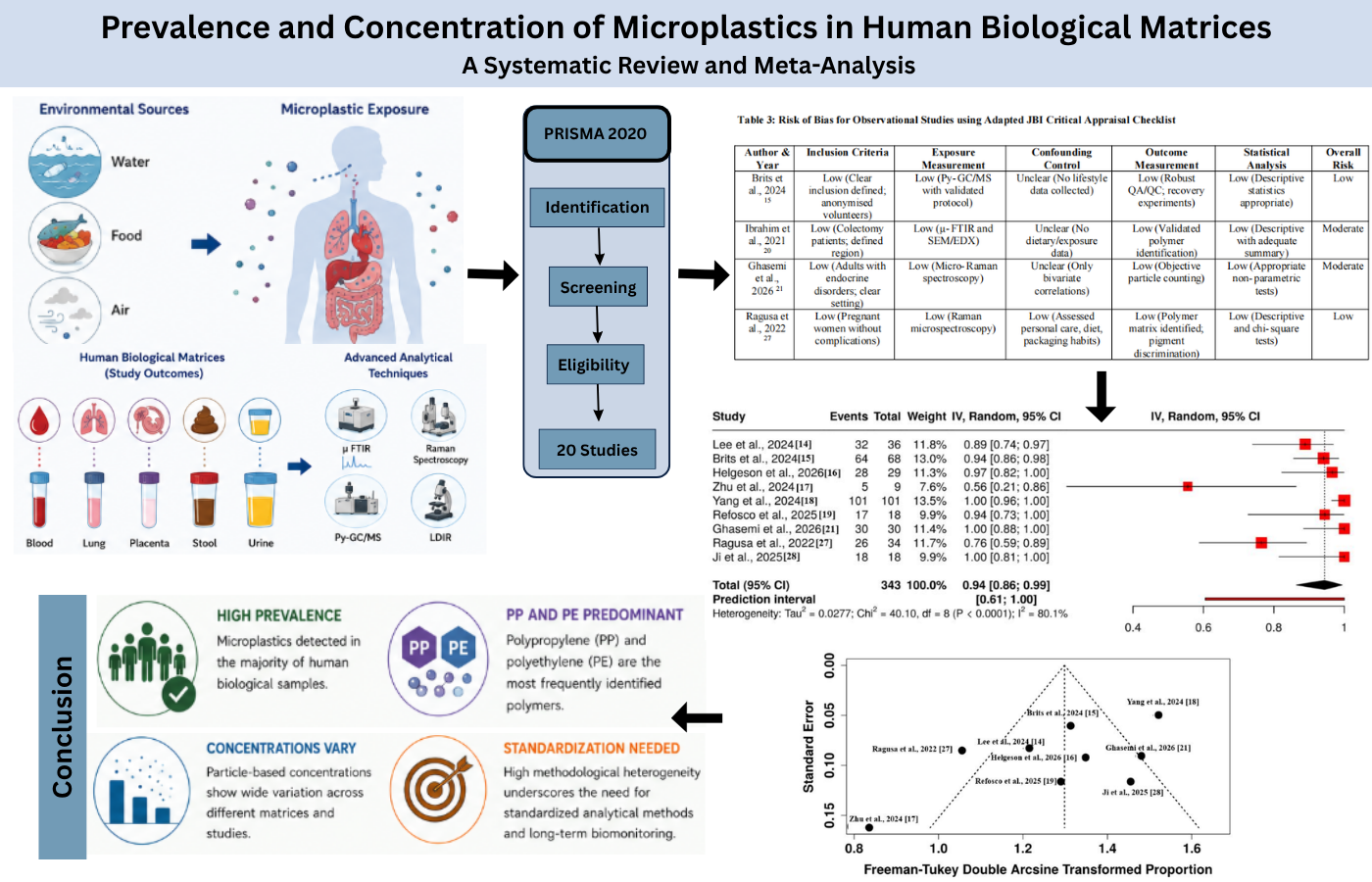
Background: Microplastics are ubiquitous environmental contaminants, which have been detected in many human biological matrices, but information on the presence, concentration and polymer types of microplastics in different matrices is fragmented. This systematic review and meta-analysis aimed to pool data on the detection rates, particle-based concentrations, and relative abundances of polypropylene (PP) and polyethylene (PE) in human biological samples. Methods: The study followed PRISMA 2020 guidelines. PubMed, Scopus, Web of Science, and Google Scholar were searched between January 2021 and April 2026. Original research publications that reported quantitative detection rates, mean concentrations, or polymer proportions in human tissues or fluids were considered. The risk of bias was assessed using the modified NOS, JBI, and ROBINS-I tool, and the certainty of evidence was graded using the GRADE approach. Meta-analysis was conducted using the Revman Tool. Results: Fifteen studies satisfied the inclusion criteria. Nine studies contributed to the detection rate meta-analysis (343 persons), providing a pooled prevalence of 0.91 (95% CI: 0.78-0.98), with significant heterogeneity (I²=87%). Seven studies (133 samples) reported particle-based concentration data, with a pooled mean of 16.0 particles/g (95% CI: 8.3-23.6; I² = 92%). The polymer proportions showed considerable heterogeneity (I²≥87%), with individual-based proportions of 0.49 (95% CI: 0.28-0.70) for PP and 0.48 (95% CI: 0.19-0.78) for PE, and particle-based proportions of 0.23 (95% CI: 0.10-0.43) for PP and 0.15 (95% CI: 0.05-0.36) for PE. Conclusion: Microplastics were found in the majority of human biological samples, albeit in varying amounts; the most often discovered polymers were PP and PE.
References
1. Rahman L, Mallach G, Kulka R, Halappanavar S. Microplastics and nanoplastics science: collecting and characterizing airborne microplastics in fine particulate matter. Nanotoxicology. 2021;15(9):1253-78. https://doi.org/10.1080/17435390.2021.2018065 DOI: https://doi.org/10.1080/17435390.2021.2018065
2. Campanale C, Massarelli C, Savino I, Locaputo V, Uricchio VF. A detailed review study on potential effects of microplastics and additives of concern on human health. Int J Environ Res Public Health. 2020;17(4):1212. https://doi.org/10.3390/ijerph17041212 DOI: https://doi.org/10.3390/ijerph17041212
3. Yong CQ, Valiyaveettil S, Tang BL. Toxicity of microplastics and nanoplastics in mammalian systems. Int J Environ Res Public Health. 2020;17(05):1509. https://doi.org/10.3390/ijerph17051509 DOI: https://doi.org/10.3390/ijerph17051509
4. Käppler A, Fischer D, Oberbeckmann S, Schernewski G, Labrenz M, Eichhorn KJ, et al. Analysis of environmental microplastics by vibrational microspectroscopy: FTIR, Raman or both? Anal Bioanal Chem. 2016;408(29):8377-91. https://doi.org/10.1007/s00216-016-9956-3 DOI: https://doi.org/10.1007/s00216-016-9956-3
5. Ivleva NP. Chemical analysis of microplastics and nanoplastics: challenges, advanced methods, and perspectives. Chem Rev. 202;121(19):11886-936. https://doi.org/10.1021/acs.chemrev.1c00178 DOI: https://doi.org/10.1021/acs.chemrev.1c00178
6. Lu W, Li X, Wang S, Tu C, Qiu L, Zhang H, et al. New evidence of microplastics in the lower respiratory tract: inhalation through smoking. Environ Sci Technol. 2023;57(23):8496-505. https://doi.org/10.1021/acs.est.3c00716 DOI: https://doi.org/10.1021/acs.est.3c00716
7. Hirt N, Body-Malapel M. Immunotoxicity and intestinal effects of nano-and microplastics: a review of the literature. Part Fibre Toxicol. 2020;17(1):57. https://doi.org/10.1186/s12989-020-00387-7 DOI: https://doi.org/10.1186/s12989-020-00387-7
8. Wright SL, Kelly FJ. Plastic and human health: a micro issue? Environ Sci Technol. 2017;51(12):6634-47. https://doi.org/10.1021/acs.est.7b00423 DOI: https://doi.org/10.1021/acs.est.7b00423
9. Parums DV. Review articles, systematic reviews, meta-analysis, and the updated preferred reporting items for systematic reviews and meta-analyses (PRISMA) 2020 guidelines. Med Sci Monit. 2021;27:e934475-1. https://doi.org/10.12659/MSM.934475 DOI: https://doi.org/10.12659/MSM.934475
10. Carra MC, Romandini P, Romandini M. Risk of Bias Evaluation of Cross‐Sectional Studies: Adaptation of the Newcastle‐Ottawa Scale. J Periodontal Res. 2025. https://doi.org/10.1111/jre.13405 DOI: https://doi.org/10.1111/jre.13405
11. Barker TH, Stone JC, Sears K, Klugar M, Leonardi-Bee J, Tufanaru C, et al. Revising the JBI quantitative critical appraisal tools to improve their applicability: an overview of methods and the development process. JBI Evidence Synthesis. 2023;21(3):478-93. https://doi.org/10.11124/JBIES-22-00125 DOI: https://doi.org/10.11124/JBIES-22-00125
12. Morgan RL, Thayer KA, Santesso N, Holloway AC, Blain R, Eftim SE, Goldstone AE, Ross P, Guyatt G, Schünemann HJ. Evaluation of the risk of bias in non-randomized studies of interventions (ROBINS-I) and the ‘target experiment’concept in studies of exposures: rationale and preliminary instrument development. Environ Int. 2018;120:382-7. https://doi.org/10.1016/j.envint.2018.08.018 DOI: https://doi.org/10.1016/j.envint.2018.08.018
13. Fekete JT, Győrffy B. MetaAnalysisOnline. com: web-based tool for the rapid meta-analysis of clinical and epidemiological studies. J Med Internet Res. 2025;27:e64016. https://preprints.jmir.org/preprint/64016 DOI: https://doi.org/10.2196/64016
14. Lee DW, Jung J, Park SA, Lee Y, Kim J, Han C, et al. Microplastic particles in human blood and their association with coagulation markers. Sci Rep. 2024;14(1):30419. https://doi.org/10.1038/s41598-024-81931-9 DOI: https://doi.org/10.1038/s41598-024-81931-9
15. Brits M, Van Velzen MJ, Sefiloglu FÖ, Scibetta L, Groenewoud Q, Garcia-Vallejo JJ, et al. Quantitation of micro and nanoplastics in human blood by pyrolysis-gas chromatography–mass spectrometry. Microplast and Nanoplast. 2024;4(1):12. https://doi.org/10.1186/s43591-024-00090-w DOI: https://doi.org/10.1186/s43591-024-00090-w
16. Helgeson SA, Alaws H, Ibrahim MI, Lee AS, Vlecken DH, Baig HZ. The Association of Microplastics in Peripheral Blood and Pulmonary Disease: A Pilot Study. J Xenobiot. 2026;16(3):72. https://doi.org/10.3390/jox16030072 DOI: https://doi.org/10.3390/jox16030072
17. Zhu M, Li X, Lin W, Zeng D, Yang P, Ni W, et al. Microplastic particles detected in fetal cord blood, placenta, and meconium: a pilot study of nine mother–infant pairs in South China. Toxics. 2024;12(12):850. https://doi.org/10.3390/toxics12120850 DOI: https://doi.org/10.3390/toxics12120850
18. Yang Y, Zhang F, Jiang Z, Du Z, Liu S, Zhang M, et al. Microplastics are associated with elevated atherosclerotic risk and increased vascular complexity in acute coronary syndrome patients. Part Fibre Toxicol. 2024;21(1):34. https://doi.org/10.1186/s12989-024-00596-4 DOI: https://doi.org/10.1186/s12989-024-00596-4
19. Refosco A, Dierkes J, Kögel T, Dankel SN, Laupsa-Borge J, Gomiero A, et al. Microplastics in human feces: A pilot study exploring links with dietary habits. Microplast Nanoplast. 2025;5(1):22. https://doi.org/10.1186/s43591-025-00129-6 DOI: https://doi.org/10.1186/s43591-025-00129-6
20. Ibrahim YS, Tuan Anuar S, Azmi AA, Wan Mohd Khalik WM, Lehata S, Hamzah SR, et al. Detection of microplastics in human colectomy specimens. JGH open. 2021;5(1):116-21. https://doi.org/10.1002/jgh3.12457 DOI: https://doi.org/10.1002/jgh3.12457
21. Ghasemi FF, Dehghani M, Dobaradaran S, Hoseini M, KalantarHormozi MR, Samaei MR. Detection and characterization of MPs in the human stool: an observational study in Bushehr, Iran. Sci Rep. 2026;16(1):9609. https://doi.org/10.1038/s41598-025-33204-2 DOI: https://doi.org/10.1038/s41598-025-33204-2
22. Rotchell JM, Jenner LC, Chapman E, Bennett RT, Bolanle IO, Loubani M, et al. Detection of microplastics in human saphenous vein tissue using μFTIR: A pilot study. PLoS One. 2023;18(2):e0280594. https://doi.org/10.1371/journal.pone.0280594 DOI: https://doi.org/10.1371/journal.pone.0280594
23. Huang S, Huang X, Bi R, Guo Q, Yu X, Zeng Q, et al. Detection and analysis of microplastics in human sputum. Environ Sci Technol. 2022;56(4):2476-86. https://doi.org/10.1021/acs.est.1c03859 DOI: https://doi.org/10.1021/acs.est.1c03859
24. Ho YW, Lim JY, Yeoh YK, Chiou JC, Zhu Y, Lai KP, et al. Preliminary findings of the high quantity of microplastics in faeces of Hong Kong residents. Toxics. 2022;10(8):414. https://doi.org/10.3390/toxics10080414 DOI: https://doi.org/10.3390/toxics10080414
25. Wang S, Lu W, Cao Q, Tu C, Zhong C, Qiu L, et al. Microplastics in the lung tissues associated with blood test index. Toxics. 2023;11(9):759. https://doi.org/10.3390/toxics11090759 DOI: https://doi.org/10.3390/toxics11090759
26. Guo Y, Rong M, Fan Y, Teng X, Jin L, Zhao Y. The Presence of Microplastics in Human Semen and Their Associations with Semen Quality. Toxics. 2025;13(7):566. https://doi.org/10.3390/toxics13070566 DOI: https://doi.org/10.3390/toxics13070566
27. Ragusa A, Notarstefano V, Svelato A, Belloni A, Gioacchini G, Blondeel C, et al. Raman microspectroscopy detection and characterisation of microplastics in human breastmilk. Polymers. 2022;14(13):2700. https://doi.org/10.3390/polym14132700 DOI: https://doi.org/10.3390/polym14132700
28. Ji S, Wang W, Wang Y, Bai H, Li Z, Huo Z, et al. Quantitative Detection of Micro-and Nanoplastics (≥ 300 nm) in Human Urine Using Double-Shot Py-GC/MS with Internal Standard Calibration. Toxics. 2025;13(6):452. https://doi.org/10.3390/toxics13060452 DOI: https://doi.org/10.3390/toxics13060452
29. Yang Z, Wang M, Feng Z, Wang Z, Lv M, Chang J, et al. Human microplastics exposure and potential health risks to target organs by different routes: A review. Curr Pollut Rep. 2023;9(3):468-85. https://doi.org/10.1007/s40726-023-00273-8 DOI: https://doi.org/10.1007/s40726-023-00273-8
30. Vethaak AD, Legler J. Microplastics and human health. Science. 2021;371(6530):672-4. https://doi.org/10.1126/science.abe5041 DOI: https://doi.org/10.1126/science.abe5041
31. Fontes BL, de Souza E Souza LC, da Silva de Oliveira AP, da Fonseca RN, Neto MP, Pinheiro CR. The possible impacts of nano and microplastics on human health: lessons from experimental models across multiple organs. J Toxicol Environ Health B. 2024;27(4):153-87. https://doi.org/10.1080/10937404.2024.2330962 DOI: https://doi.org/10.1080/10937404.2024.2330962
32. Cox KD, Covernton GA, Davies HL, Dower JF, Juanes F, Dudas SE. Human consumption of microplastics. Environ Sci Technol. 2019;53(12):7068-74. https://doi.org/10.1021/acs.est.9b01517 DOI: https://doi.org/10.1021/acs.est.9b01517
33. Enyoh CE, Devi A, Kadono H, Wang Q, Rabin MH. The plastic within: microplastics invading human organs and bodily fluids systems. Environments. 2023;10(11):194. https://doi.org/10.3390/environments10110194 DOI: https://doi.org/10.3390/environments10110194
34. Prata JC. Microplastics and human health: Integrating pharmacokinetics. Crit Rev Environ Sci Technol. 2023;53(16):1489-511. https://doi.org/10.1080/10643389.2023.2195798 DOI: https://doi.org/10.1080/10643389.2023.2195798
35. Sun A, Wang WX. Human exposure to microplastics and its associated health risks. Environ Health. 2023;1(3):139-49. https://doi.org/10.1021/envhealth.3c00053 DOI: https://doi.org/10.1021/envhealth.3c00053
36. Geyer R, Jambeck JR, Law KL. Production, use, and fate of all plastics ever made. Sci Adv. 2017;3(7):e1700782. https://doi.org/10.1126/sciadv.1700782 DOI: https://doi.org/10.1126/sciadv.1700782
37. Adam V, Yang T, Nowack B. Toward an ecotoxicological risk assessment of microplastics: Comparison of available hazard and exposure data in freshwaters. Environ Toxicol Chem. 2019;38(2):436-47. https://doi.org/10.1002/etc.4323 DOI: https://doi.org/10.1002/etc.4323
38. Besley A, Vijver MG, Behrens P, Bosker T. A standardized method for sampling and extraction methods for quantifying microplastics in beach sand. Mar Pollut Bull. 2017;114(1):77-83. https://doi.org/10.1016/j.marpolbul.2016.08.055 DOI: https://doi.org/10.1016/j.marpolbul.2016.08.055
39. Zarfl C. Promising techniques and open challenges for microplastic identification and quantification in environmental matrices. Anal Bioanal Chem. 2019;411(17):3743-56. https://doi.org/10.1007/s00216-019-01763-9 DOI: https://doi.org/10.1007/s00216-019-01763-9
Published
Issue
Section
License
Copyright (c) 2026 Aliya Ahmed Abdellah Ahmed, Shareefa Bint-e Umar, Khadeejah Qadir, Zehra S. Sharif (Author)

This work is licensed under a Creative Commons Attribution-NonCommercial 4.0 International License.
Al-Najam Journal of Medical and Life Sciences (ANJMLS) follows the Attribution Creative Commons-Non commercial (CC BY-NC) license which allows the users to copy and redistribute the material in any medium or format, remix, transform and build upon the material. The users must give credit to the source and indicate, provide a link to the license, and indicate if changes were made. However, the CC BY-NC license restricts the use of material for commercial purposes (Further details are available at website. The Editorial Board of the ANJMLS endeavors to ensure the accuracy, integrity, and quality of all published content. However, the responsibility of opinions, interpretations, and conclusions expressed in the published articles rests entirely with the authors and do not necessarily reflect the views of the Editorial Board, publisher, or affiliated institutions.