Assessment of Laboratory Knowledge, Practical Competency, and Learning Outcomes Among Undergraduate Medical Students
DOI:
https://doi.org/10.68041/anjmls.v1i2/03Keywords:
Medical Education, Laboratory Competency, Academic Engagement, knowledge Score, Cross-sectional Study, Statistical AnalysisAbstract
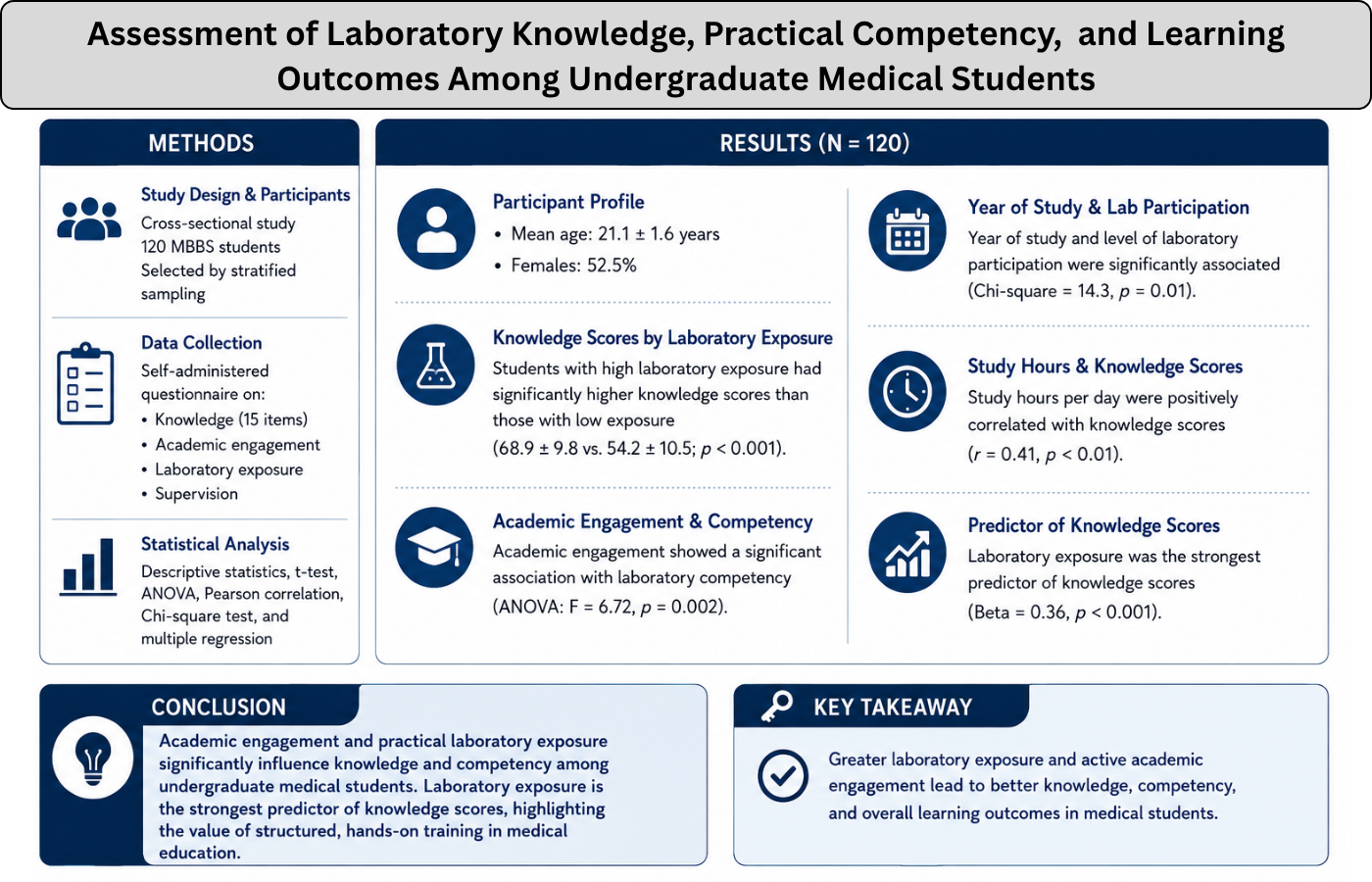
Background: Medical education is based on the support of theory, academic activity and competency in the laboratory. The aim of this study was to assess the academic engagement, lab exposure and knowledge scores of medical undergraduate students and to statistically associate them. Methods: This cross sectional analytical study (n=120) used stratified sampling technique and a structured questionnaire was developed specifically for the study, which included a knowledge assessment score test (15 items) to assess the level of knowledge, a frequency score test to assess the level of academic engagement (study hours, attendance and use of digital learning), a hands-on participation score test to assess the level of exposure on the laboratory, and a supervision score test to assess the level of supervision in the laboratory. SPSS v26 was used for the statistical analysis. Descriptive statistics (mean ± SD and percentages) were calculated. Independent t-test and one-way ANOVA were used for group comparisons. Pearson correlation coefficient and Chi square test were used to examine the relationship between the variables, at p < 0.05 significance level. Results: Out of 120 participants, the mean age was 21.1 ± 1.6 years with 52.5% of females. There was a significant difference in the knowledge scores between students with high and low laboratory exposure (68.9 ± 9.8 vs 54.2 ± 10.5, p < 0.001). There was a moderate positive correlation between the study hours and knowledge score (r = 0.41, p < 0.01). Academic engagement (ANOVA, F = 6.72, p = 0.002) was a significant factor for laboratory competency scores. A significant correlation between year of study and level of lab participation was found using a chi-square test (χ² = 14.3, p = 0.01). Generally, regression analysis showed that laboratory exposure had the highest beta (0.36, p < 0.001) that contributed to the knowledge score. Conclusions: Academic involvement and practical experience in the laboratory have a significant effect on the knowledge building and skill acquisition of medical students.
References
1. Christian RJ, Baccon J, Knollmann-Ritschel B, Elliott K, Laposata M, Conran RM. The need for laboratory medicine in the undergraduate medical education curriculum: A white paper from the Association of Pathology Chairs. Med Sci Educ. 2023;34(1):193-200. https://doi.org/10.1007/s40670-023-01895-9
2. Laboratory Test Working Group. Essential laboratory tests for medical education. Acad Pathol. 2022;9(1):100046. https://doi.org/10.1016/j.acpath.2022.100046
3. Jafri L, Abid MA, Rehman J, Ahmed S, Abbas G, Ali H, et al. Development of a virtual classroom for pre-analytical phase of laboratory medicine for undergraduate medical students using the Delphi technique. PLoS One. 2022;17(4). https://doi.org/10.1371/journal.pone.0264447 DOI: https://doi.org/10.1371/journal.pone.0264447
4. Knollmann-Ritschel BEC, Huppmann AR, Borowitz MJ, Conran R. Pathology competencies in medical education and educational cases: update 2023. Acad Pathol. 2023;10(3):100086. https://doi.org/10.1016/j.acpath.2023.100086 DOI: https://doi.org/10.1016/j.acpath.2023.100086
5. Shen J, Qi H, Chen Y, Mei R, Sun C, Wang Z. Incorporating modified team-based learning into a flipped basic medical laboratory course: impact on student performance and perceptions. BMC Med Educ. 2022;22:608. https://doi.org/10.1186/s12909-022-03676-1
6. Qu M, Hou Q, Li X, Yu C, Xia J, Dong Z. Application of a flipped classroom incorporating modified team-based learning in molecular biology laboratory teaching: a mixed methods study. BMC Med Educ. 2024;24:1442. https://doi.org/10.1186/s12909-024-06450-7
7. Abraham R, Singaram VS. Self and peer feedback engagement and receptivity among medical students with varied academic performance in the clinical skills laboratory. BMC Med Educ. 2024;24:1065. https://doi.org/10.1186/s12909-024-06084-9
8. Gupta SK, Srivastava T. Assessment in undergraduate competency-based medical education: a systematic review. Cureus. 2024;16(4). https://doi.org/10.7759/cureus.58073
9. Ashraf MA, Tsegay SM, Gull N, Saeed M, Dawood H. The role of blended learning in improving medical students’ academic performance: evidence from Pakistan. Front Med. 2024;11:1425659. https://doi.org/10.3389/fmed.2024.1425659
10. Yang Y, Tian J, Chen B, Chen S. Knowledge and attitudes toward clinical laboratory medicine among undergraduate medical interns in China: a cross-sectional survey. Front Med. 2025;12:1671631. https://doi.org/10.3389/fmed.2025.1671631
11. Haile SA, Rose WN. An open-access laboratory medicine course for medical students. Acad Pathol. 2023;10(1):100066. https://doi.org/10.1016/j.acpath.2022.100066
12. Do M, Sanford K, Roseff S, Hovaguimian A, Besche H, Fischer K. Gamified versus non-gamified online educational modules for teaching clinical laboratory medicine to first-year medical students at a large allopathic medical school in the United States. BMC Med Educ. 2023;23:959. https://doi.org/10.1186/s12909-023-04951-5
13. Gummesson C, Alm S, Cederborg A, Ekstedt M, Hellman J, Hjelmqvist H, et al. Entrustable professional activities for undergraduate medical education: development and exploration of social validity. BMC Med Educ. 2023;23:635. https://doi.org/10.1186/s12909-023-04621-6 DOI: https://doi.org/10.1186/s12909-023-04621-6
14. Yang Y, Xu S, Chen S, Tian J, Chen B. Development and validation of a questionnaire for laboratory medicine knowledge and attitudes in clinical medical interns. Front Med. 2025;12:1726666. https://doi.org/10.3389/fmed.2025.1726666
15. Feng Y, Zhao B, Zheng J, Fu Y, Jiang Y. Online flipped classroom with team-based learning promoted learning activity in a clinical laboratory immunology class: response to the COVID-19 pandemic. BMC Med Educ. 2022;22:836. https://doi.org/10.1186/s12909-022-03917-3 DOI: https://doi.org/10.1186/s12909-022-03917-3
16. Lu Q, Dou H, Shen S. From technique mastery to scientific thinking: how open-ended experiments shape medical students’ perception of laboratory course roles in China. BMC Med Educ. 2024;24:1488. https://doi.org/10.1186/s12909-024-06325-x DOI: https://doi.org/10.1186/s12909-024-06325-x
17. Shen J, Qi H, Chen Y, Mei R, Sun C, Wang Z. Incorporating modified team-based learning into a flipped basic medical laboratory course: impact on student performance and perceptions. BMC Med Educ. 2022;22:608. https://doi.org/10.1186/s12909-022-03676-1 DOI: https://doi.org/10.1186/s12909-022-03676-1
18. Qu M, Hou Q, Li X, Yu C, Xia J, Dong Z. Application of a flipped classroom incorporating modified team-based learning in molecular biology laboratory teaching: a mixed methods study. BMC Med Educ. 2024;24:1442. https://doi.org/10.1186/s12909-024-06450-7 DOI: https://doi.org/10.1186/s12909-024-06450-7
19. Do M, Sanford K, Roseff S, Hovaguimian A, Besche H, Fischer K. Gamified versus non-gamified online educational modules for teaching clinical laboratory medicine to first-year medical students at a large allopathic medical school in the United States. BMC Med Educ. 2023;23:959. https://doi.org/10.1186/s12909-023-04951-5 DOI: https://doi.org/10.1186/s12909-023-04951-5
20. Yang Y, Tian J, Chen B, Chen S. Knowledge and attitudes toward clinical laboratory medicine among undergraduate medical interns in China: a cross-sectional survey. Front Med. 2025;12:1671631. https://doi.org/10.3389/fmed.2025.1671631 DOI: https://doi.org/10.3389/fmed.2025.1671631
21. Yang Y, Xu S, Chen S, Tian J, Chen B. Development and validation of a questionnaire for laboratory medicine knowledge and attitudes in clinical medical interns. Front Med. 2025;12:1726666. https://doi.org/10.3389/fmed.2025.1726666 DOI: https://doi.org/10.3389/fmed.2025.1726666
22. Haile SA, Rose WN. An open-access laboratory medicine course for medical students. Acad Pathol. 2023;10(1):100066. https://doi.org/10.1016/j.acpath.2022.100066 DOI: https://doi.org/10.1016/j.acpath.2022.100066
23. Christian RJ, Baccon J, Knollmann-Ritschel B, Elliott K, Laposata M, Conran RM. The need for laboratory medicine in the undergraduate medical education curriculum: A white paper from the Association of Pathology Chairs. Med Sci Educ. 2023;34(1):193-200. https://doi.org/10.1007/s40670-023-01895-9 DOI: https://doi.org/10.1007/s40670-023-01895-9
24. Laboratory Test Working Group. Essential laboratory tests for medical education. Acad Pathol. 2022;9(1):100046. https://doi.org/10.1016/j.acpath.2022.100046 DOI: https://doi.org/10.1016/j.acpath.2022.100046
25.Gupta SK, Srivastava T. Assessment in undergraduate competency-based medical education: a systematic review. Cureus. 2024;16(4). https://doi.org/10.7759/cureus.58073 DOI: https://doi.org/10.7759/cureus.58073
26. Abraham R, Singaram VS. Self and peer feedback engagement and receptivity among medical students with varied academic performance in the clinical skills laboratory. BMC Med Educ. 2024;24:1065. https://doi.org/10.1186/s12909-024-06084-9 DOI: https://doi.org/10.1186/s12909-024-06084-9
27. Ashraf MA, Tsegay SM, Gull N, Saeed M, Dawood H. The role of blended learning in improving medical students’ academic performance: evidence from Pakistan. Front Med. 2024;11:1425659. https://doi.org/10.3389/fmed.2024.1425659 DOI: https://doi.org/10.3389/fmed.2024.1425659
28. Elendu C, Amaechi DC, Okatta AU, Amaechi EC, Elendu TC, Ezeh CP, et al. The impact of simulation-based training in medical education: a review. Medicine. 2024;103(27). https://doi.org/10.1097/MD.0000000000038813 DOI: https://doi.org/10.1097/MD.0000000000038813
29. Rajaure YS, Thapa B, Budhathoki L, Rana SRL, Neupane R, Karki P. Assessment of performance and confidence level of simulation-based clinical examination of respiratory system in undergraduate medical students of a medical college: a comparative cross-sectional study. Ann Med Surg. 2024;86(2):785-790. https://doi.org/10.1097/MS9.0000000000001652 DOI: https://doi.org/10.1097/MS9.0000000000001631
Published
Issue
Section
License
Copyright (c) 2026 Tanzeel Qadri, Saba Ikram, Mohsin Khalil (Author)

This work is licensed under a Creative Commons Attribution-NonCommercial 4.0 International License.
Al-Najam Journal of Medical and Life Sciences (ANJMLS) follows the Attribution Creative Commons-Non commercial (CC BY-NC) license which allows the users to copy and redistribute the material in any medium or format, remix, transform and build upon the material. The users must give credit to the source and indicate, provide a link to the license, and indicate if changes were made. However, the CC BY-NC license restricts the use of material for commercial purposes (Further details are available at website. The Editorial Board of the ANJMLS endeavors to ensure the accuracy, integrity, and quality of all published content. However, the responsibility of opinions, interpretations, and conclusions expressed in the published articles rests entirely with the authors and do not necessarily reflect the views of the Editorial Board, publisher, or affiliated institutions.