Region-Specific Alterations in Brain UPE in Alzheimer’s Disease
Keywords:
Alzheimer's Disease, Dementia, Oxidative Stress, Neurodegenerative Diseases, MitochondriaAbstract
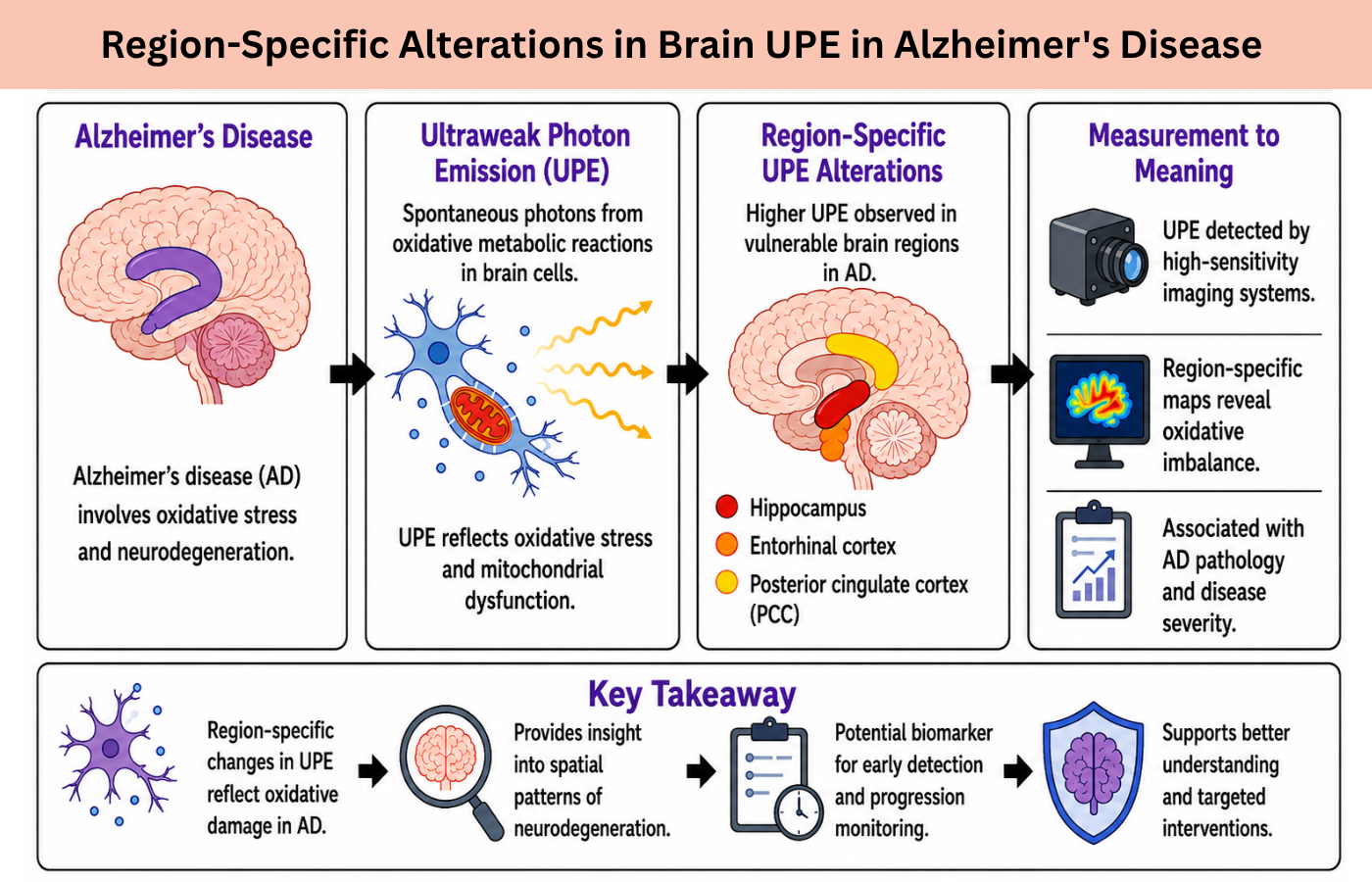
Alzheimer’s disease (AD) is the most common cause of dementia in the world, and it is marked by deterioration of cognitive functions; the formation of amyloid-β in the brain; and tau, the formation of tau pathology; synaptic degeneration; and local susceptibility, especially in the hippocampus and association cortices. The most common processes identified to cause neuronal injury and disease development are oxidative stress and mitochondrial dysfunction. Ultraweak photon emission (UPE), a spontaneous biophotonic emission in response to oxidative metabolic reactions, has become a possible cellular redox imbalance and neural activity indicator. Since oxidative changes in AD are region-specific, UPE can indicate region-specific neurodegeneration. Nevertheless, existing research on brain UPE in AD is insufficient and primarily focuses on global oxidative indicators, rather than regional patterns. Lack of systematic analysis of the region-specific UPE changes is also a major gap in research. This aims the regional differences in brain UPE in Alzheimer’s, and determine whether they correlate with oxidative imbalance and neuropathological severity. The detection of specific UPE signatures could contribute to the enhanced comprehension of spatial disease heterogeneity and aid in its advancement as a possible functional biomarker of the early disease detection and progression tracking.
References
1. Livingston G, Huntley J, Sommerlad A, Ames D, Ballard C, Banerjee S, et al. Dementia prevention, intervention, and care: 2020 report of the Lancet Commission. The Lancet. 2020;396(10248):413-46. https://doi.org/10.1016/S0140-6736(20)30367-6
2. Knopman DS, Amieva H, Petersen RC, Chételat G, Holtzman DM, Hyman BT, et al. Alzheimer disease. Nat. Rev. Dis. Primers. 2021;7(1):33. https://doi.org/10.1038/s41572-021-00269-y
3. DeTure MA, Dickson DW. The neuropathological diagnosis of Alzheimer's disease. Mol Neurodegener. 2019;14(1):32. https://doi.org/10.1186/s13024-019-0333-5
4. Long JM, Holtzman DM. Alzheimer’s Disease: An Update on Pathobiology and Treatment Strategies. Cell. 2019;179(2):312-39. https://doi.org/10.1016/j.cell.2019.09.001
5. Cifra M, Pospíšil P. Ultra-weak photon emission from biological samples: Definition, mechanisms, properties, detection and applications. Journal of Photochemistry and Photobiology B: Biology. 2014;139:2-10. https://doi.org/10.1016/j.jphotobiol.2014.02.009
6. Tsuchida K, Iwasa T, Kobayashi M. Imaging of ultraweak photon emission for evaluating the oxidative stress of human skin. J Photochem Photobiol B. 2019;198:111562. https://doi.org/10.1016/j.jphotobiol.2019.111562
7. Braak H, Del Tredici K. Spreading of Tau Pathology in Sporadic Alzheimer’s Disease Along Cortico-cortical Top-Down Connections. Cerebral Cortex. 2018;28(9):3372-84. https://doi.org/10.1093/cercor/bhy152
8. Butterfield DA, Halliwell B. Oxidative stress, dysfunctional glucose metabolism and Alzheimer disease. Nat. Rev. Neurosci.. 2019;20(3):148-60. https://doi.org/10.1038/s41583-019-0132-6
9. Wang W, Zhao F, Ma X, Perry G, Zhu X. Mitochondria dysfunction in the pathogenesis of Alzheimer's disease: recent advances. Mol Neurodegener. 2020;15(1):30. https://doi.org/10.1186/s13024-020-00376-6
10. Jagust W. Imaging the evolution and pathophysiology of Alzheimer disease. Nature Reviews Neuroscience. 2018;19(11):687-700. https://doi.org/10.1038/s41583-018-0067-3
Downloads
Published
Issue
Section
License
Copyright (c) 2026 Hamayun Saqib (Author)

This work is licensed under a Creative Commons Attribution-NonCommercial 4.0 International License.
Al-Najam Journal of Medical and Life Sciences (ANJMLS) follows the Attribution Creative Commons-Non commercial (CC BY-NC) license which allows the users to copy and redistribute the material in any medium or format, remix, transform and build upon the material. The users must give credit to the source and indicate, provide a link to the license, and indicate if changes were made. However, the CC BY-NC license restricts the use of material for commercial purposes (Further details are available at website. The Editorial Board of the ANJMLS endeavors to ensure the accuracy, integrity, and quality of all published content. However, the responsibility of opinions, interpretations, and conclusions expressed in the published articles rests entirely with the authors and do not necessarily reflect the views of the Editorial Board, publisher, or affiliated institutions.