Plant Cell Wall Engineering: Redefining Industrial Biomass through Molecular Innovation
DOI:
https://doi.org/10.68041/anjmls.v1i1/02Keywords:
Lignocellulosic biomass, Cell wall recalcitrance, Saccharification efficiency, Lignin biosynthesis, CRISPR/Cas9, Biomass engineeringAbstract
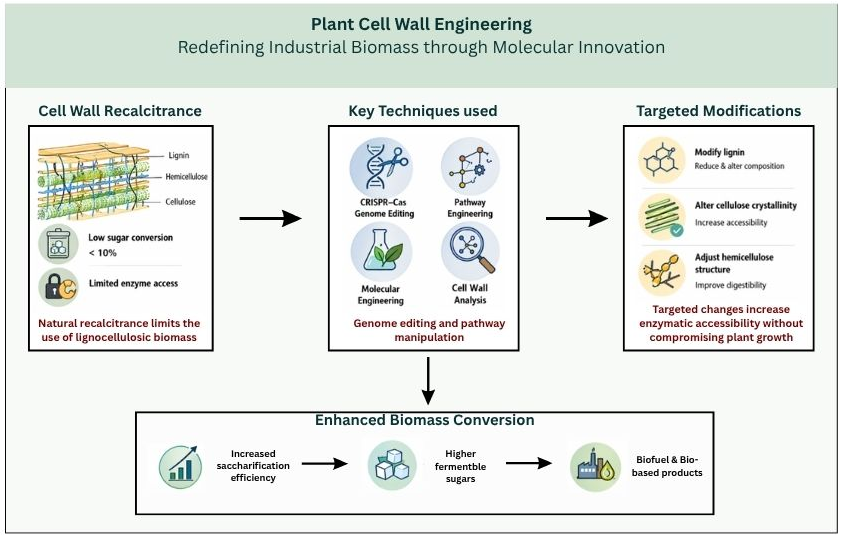
Biomass, particularly lignocellulosic biomass, a promising renewable energy source in the production of biofuel and bio-based products, but its effective use is limited due to the cell wall recalcitrance. The intricate structure of the plant cell wall limits the enzymatic accessibility, which leads to the low conversion efficiency of less than 10% into fermentable sugars. Recent developments in molecular and genetic engineering, especially the CRISPR-Cas based genome editing and pathway manipulation, have enabled the targeted modifications of the cell wall components. Experimental results show that modifications of lignin biosynthesis and composition have the potential to increase saccharification efficiency without causing growth penalties. Cellulose crystallinity and hemicellulose structure modifications can enhance the digestibility of biomass. This review critically discusses the molecular basis of cell wall recalcitrance, recent experimental approaches to reduce the recalcitrance, and evaluates their industrial relevance in enhancing biomass conversion efficiency.
References
1. Broda M, Yelle DJ, Serwańska K. Bioethanol production from lignocellulosic biomass-challenges and solutions. Molecules. 2022;27(24):8717. https://doi.org/10.3390/molecules27248717 DOI: https://doi.org/10.3390/molecules27248717
2. Zoghlami A, Paës G. Lignocellulosic biomass: understanding recalcitrance and predicting hydrolysis. Front Chem. 2019;7:874. https://doi.org/10.3389/fchem.2019.00874 DOI: https://doi.org/10.3389/fchem.2019.00874
3. Lakhawat SS, Malik N, Kumar V, Kumar S, Sharma PK. Implications of CRISPR-Cas9 in developing next generation biofuel: a mini-review. Curr Protein Pept Sci. 2022;23(9):574-84. https://doi.org/10.2174/1389203723666220907110310 DOI: https://doi.org/10.2174/1389203723666220907110310
4. Jang HA, Bae EK, Kim MH, Park SJ, Choi NY, Pyo SW, et al. CRISPR-knockout of CSE gene improves saccharification efficiency by reducing lignin content in hybrid poplar. Int J Mol Sci. 2021;22(18):9750. https://doi.org/10.3390/ijms22189750 DOI: https://doi.org/10.3390/ijms22189750
5. Aslam H. CRISPR-Mediated Engineering of Lignin Biosynthesis to Reduce Plant Biomass Recalcitrance: Advances, Trade-offs, and Future Directions: CRISPR-Mediated Engineering of Lignin Biosynthesis to Reduce Plant Biomass Recalcitrance. Futuristic Biotechnol. 2026:11-8. https://doi.org/10.54393/fbt.v6i1.226 DOI: https://doi.org/10.54393/fbt.v6i1.226
6. Li F, Liu S, Xu H, Xu Q. A novel FC17/CESA4 mutation causes increased biomass saccharification and lodging resistance by remodeling cell wall in rice. Biotechnol Biofuels. 2018;11(1):298. https://doi.org/10.1186/s13068-018-1298-2 DOI: https://doi.org/10.1186/s13068-018-1298-2
7. Xu H, Che X, Ding Y, Kong Y, Li B, Tian W. Effect of crystallinity on pretreatment and enzymatic hydrolysis of lignocellulosic biomass based on multivariate analysis. Bioresour Technol. 2019;279:271-80. https://doi.org/10.1016/j.biortech.2018.12.096 DOI: https://doi.org/10.1016/j.biortech.2018.12.096
8. Qaseem MF, Wu AM. Balanced xylan acetylation is the key regulator of plant growth and development, and cell wall structure and for industrial utilization. Int J Mol Sci. 2020;21(21):7875. https://doi.org/10.3390/ijms21217875 DOI: https://doi.org/10.3390/ijms21217875
9. Chaudhari AA, Sharma AM, Rastogi L, Dewangan BP, Sharma R, Singh D, et al. Modifying lignin composition and xylan O-acetylation induces changes in cell wall composition, extractability, and digestibility. Biotechnol Biofuels Bioprod. 2024;17(1):73. https://doi.org/10.1186/s13068-024-02513-5 DOI: https://doi.org/10.1186/s13068-024-02513-5
10. Wilkerson CG, Mansfield SD, Lu F, Withers S, Park JY, Karlen SD, et al. Monolignol ferulate transferase introduces chemically labile linkages into the lignin backbone. Science. 2014;344(6179):90-3. https://doi.org/10.3389/fpls.2026.1730538 DOI: https://doi.org/10.1126/science.1250161
11. Unda F, de Vries L, Karlen SD, Rainbow J, Zhang C, Bartley LE, et al. Enhancing monolignol ferulate conjugate levels in poplar lignin via OsFMT1. Biotechnol Biofuels Bioprod. 2024;17(1):97. https://doi.org/10.1186/s13068-024-02544-y DOI: https://doi.org/10.1186/s13068-024-02544-y
12. Sirangelo TM, Ludlow RA, Chenet T, Pasti L, Spadafora ND. Multi-Omics and genome editing studies on plant cell walls to improve biomass quality. Agriculture. 2023;13(4):752. https://doi.org/10.3390/agriculture13040752 DOI: https://doi.org/10.3390/agriculture13040752
13. Aznar A, Chalvin C, Shih PM, Maimann M, Ebert B, Birdseye DS, et al. Gene stacking of multiple traits for high yield of fermentable sugars in plant biomass. Biotechnol Biofuels. 2018;11(1):2. https://doi.org/10.1186/s13068-017-1007-6 DOI: https://doi.org/10.1186/s13068-017-1007-6
14. Ashokkumar V, Venkatkarthick R, Jayashree S, Chuetor S, Dharmaraj S, Kumar G, et al. Recent advances in lignocellulosic biomass for biofuels and value-added bioproducts-A critical review. Bioresour Technol. 2022;344:126195. https://doi.org/10.1016/j.biortech.2021.126195 DOI: https://doi.org/10.1016/j.biortech.2021.126195
15. Yadav J, Marwah H, Kumar C. Synthetic biology and metabolic engineering paving the way for sustainable next-gen biofuels: a comprehensive review. Energy Adv. 2025;4(10):1209-28. https://doi.org/10.1039/D5YA00118H DOI: https://doi.org/10.1039/D5YA00118H
Published
Issue
Section
License
Copyright (c) 2026 Hafsa Aslam

This work is licensed under a Creative Commons Attribution-NonCommercial 4.0 International License.
Al-Najam Journal of Medical and Life Sciences (ANJMLS) follows the Attribution Creative Commons-Non commercial (CC BY-NC) license which allows the users to copy and redistribute the material in any medium or format, remix, transform and build upon the material. The users must give credit to the source and indicate, provide a link to the license, and indicate if changes were made. However, the CC BY-NC license restricts the use of material for commercial purposes (Further details are available at website. The Editorial Board of the ANJMLS endeavors to ensure the accuracy, integrity, and quality of all published content. However, the responsibility of opinions, interpretations, and conclusions expressed in the published articles rests entirely with the authors and do not necessarily reflect the views of the Editorial Board, publisher, or affiliated institutions.