Assessment of Cognitive Function Using the Mini-Mental State Examination Among Community-Dwelling Older Adults: A Cross-Sectional Study
Keywords:
Mini-Mental State Examination, cross-sectional study, community-dwelling elderly, cognitive function, cognitive impairment, older adults, memory assessment, agingAbstract
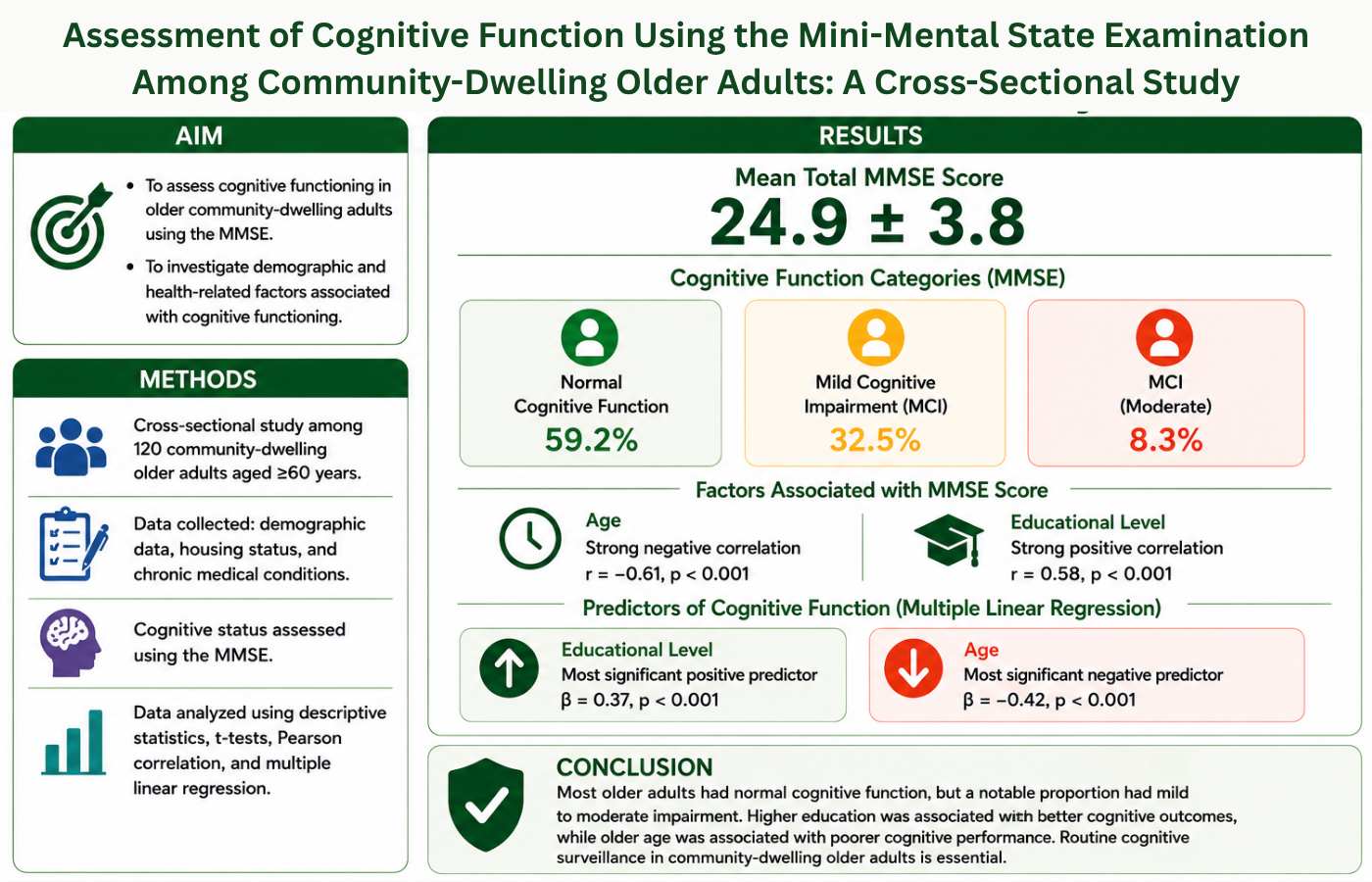
Background: Cognitive decline is a common concern of the elderly, which can have a negative impact on memory, function, independence and quality of life for older individuals. The purpose of this study was to evaluate cognitive functioning in older people in the community using the MMSE and to determine the demographic and health-related factors that are associated with cognitive functioning. Methodology: Cross sectional survey based (n=120) structured questionnaire included demographic data, housing status, and chronic medical conditions (i.e. diabetes, hypertension, asthma, epilepsy, lung disease, heart disease, cancer, HIV, AIDS). The cognitive status was assessed by MMSE. Descriptive analysis, independent-samples t-tests, Pearson correlation analysis and multiple linear regression were used to analyze the data obtained (p-value < 0.05). Results: The average total MMSE score was 24.9 ± 3.8. Of all participants, 59.2% had normal cognitive function; 32.5% had MCI and 8.3% had MCI (moderate). The age groups and educational levels/housing status differed significantly from each other in MMSE score (p < 0.05). Correlation between age and MMSE score was strong and negative (r = −0.61, p < 0.001) while educational level was strongly and positively correlated with MMSE (r = 0.58, p < 0.001). Educational level was the most significant positive predictor (β = 0.37, p < 0.001) while age was the most significant negative predictor (β = −0.42, p < 0.001) in multiple linear regression. Conclusion: The cognitive function was normal in the majority of older adults living in the community, but a significant portion of study participants had mild to moderate impairment. Better cognitive outcomes were correlated with education and older age was correlated with poorer cognitive performance.
References
1. GBD 2019 Dementia Forecasting Collaborators. Estimation of the global prevalence of dementia in 2019 and forecasted prevalence in 2050: an analysis for the Global Burden of Disease Study 2019. Lancet Public Health. 2022;7(2)–e125. https://doi.org/10.1016/S2468-2667(21)00249-8
2. Livingston G, Huntley J, Liu KY, Costafreda SG, Selbæk G, Alladi S, et al. Dementia prevention, intervention, and care: 2024 report of the Lancet standing Commission. Lancet. 2024;404(10452):572–628. https://doi.org/10.1016/S0140-6736(24)01296-0
3. Alzheimer’s Association. 2024 Alzheimer’s disease facts and figures. Alzheimers Dement. 2024;20(5):3708–3821. https://doi.org/10.1002/alz.13809
4. Salari N, Lotfi F, Abdolmaleki A, Heidarian P, Rasoulpoor S, Fazeli J, et al. The global prevalence of mild cognitive impairment in geriatric population with emphasis on influential factors: a systematic review and meta-analysis. BMC Geriatr. 2025;25(1):313. https://doi.org/10.1186/s12877-025-05967-w
5. Lee J. Mild cognitive impairment in relation to Alzheimer’s disease: an investigation of principles, classifications, ethics, and problems. Neuroethics. 2023;16(1):16. https://doi.org/10.1007/s12152-023-09522-5
6. Wu J, Yin X, Ji W, Liu Y, Zhang X, Lu L, et al. Hypertension and diabetes on cognitive impairment: a case–control study in China. Alzheimers Res Ther. 2025;17(1):120. https://doi.org/10.1186/s13195-025-01761-3
7. Miao MY, Fang F, Lyu JQ, Liu ZY, Wan ZX, Qin LQ, et al. Relationships of social isolation and loneliness with healthy aging among older adults. BMC Geriatr. 2025;25(1):267. https://doi.org/10.1186/s12877-025-05941-6
8. Pellicer-Espinosa I, Díaz-Orueta U. Cognitive screening instruments for older adults with low educational and literacy levels: a systematic review. J Appl Gerontol. 2022;41(4):1222–1231. https://doi.org/10.1177/07334648211056230
9. Truong QC, Cervin M, Choo CC, Numbers K, Bentvelzen AC, Kochan NA, et al. Examining the validity of the Mini-Mental State Examination and its domains using network analysis. Psychogeriatrics. 2024;24(2):259–271. https://doi.org/10.1111/psyg.13069
10. Baek MJ, Park YH, Kim S. The validity and reliability of the Mini-Mental State Examination-2 for detecting vascular mild cognitive impairment and vascular dementia in a Korean population. J Korean Med Sci. 2025;40(27). https://doi.org/10.3346/jkms.2025.40.e207
11. Maduro PA, Carvalho LPDC, Maduro LAR, Rodrigues ABDC, Rocha ASL, Matos LRRS, et al. Accuracy of the Mini-Mental State Examination and Montreal Cognitive Assessment in detecting cognitive impairment in older adults: a comparative study adjusted for educational level. NeuroSci. 2025;6(3):86. https://doi.org/10.3390/neurosci6030086
12. Kistler-Fischbacher M, Gohar G, de Godoi Rezende Costa Molino C, Geiling K, Meyer-Heim T, Kressig RW, et al. Cognitive function in generally healthy adults age 70 years and older in the 5-country DO-HEALTH study: MMSE and MoCA scores by sex, education and country. Aging Clin Exp Res. 2025;37(1):88. https://doi.org/10.1007/s40520-025-02946-4
13. Salari N, Lotfi F, Abdolmaleki A, Heidarian P, Rasoulpoor S, Fazeli J, et al. The global prevalence of mild cognitive impairment in geriatric population with emphasis on influential factors: a systematic review and meta-analysis. BMC Geriatr. 2025;25(1):313. https://doi.org/10.1186/s12877-025-05967-w
14. Wu X, Tang Y, He Y, Wang Q, Wang Y, Qin X. Prevalence of cognitive impairment and its related factors among Chinese older adults: an analysis based on the 2018 CHARLS data. Front Public Health. 2024;12:1500172. https://doi.org/10.3389/fpubh.2024.1500172
15. Tawfik AA, Hamza SA, Adly NN, Abdel Kader RM. Pattern of cognitive impairment among community-dwelling elderly in Egypt and its relation to socioeconomic status. J Egypt Public Health Assoc. 2024;99(1):4. https://doi.org/10.1186/s42506-023-00147-3
16. Delbari A, Tabatabaei FS, Ghasemi H, Azimi A, Bidkhori M, Saatchi M, et al. Prevalence and associated factors of mild cognitive impairment among middle-aged and older adults: results of the first phase of Ardakan Cohort Study on Aging. Health Sci Rep. 2024;7(1). https://doi.org/10.1002/hsr2.1827
17. Xiang J, Xiong Y, Liang H, Mao Q, Zhang Y, Li Y, et al. Latent profiles and correlates factors of cognitive function in older adults: a cross-sectional study. Front Aging Neurosci. 2025;17:1622804. https://doi.org/10.3389/fnagi.2025.1622804
18. Truong QC, Cervin M, Choo CC, Numbers K, Bentvelzen AC, Kochan NA, et al. Examining the validity of the Mini-Mental State Examination (MMSE) and its domains using network analysis. Psychogeriatrics. 2024;24(2):259–271. https://doi.org/10.1111/psyg.13069
19. Kistler-Fischbacher M, Gohar G, de Godoi Rezende Costa Molino C, Geiling K, Meyer-Heim T, Kressig RW, et al. Cognitive function in generally healthy adults age 70 years and older in the 5-country DO-HEALTH study: MMSE and MoCA scores by sex, education and country. Aging Clin Exp Res. 2025;37(1):88. https://doi.org/10.1007/s40520-025-02946-4
20. Albuloshi T, Kamel AM, Alsaber AR, Alawadhi B, Pan J, Abd-El-Gawad WM, et al. Factors associated with cognitive function outcomes among older adults in Kuwait: a cross-sectional study. BMC Geriatr. 2025;25(1):249. https://doi.org/10.1186/s12877-025-05882-0
21. Ma C, Li M, Wu C. Cognitive function trajectories and factors among Chinese older adults with subjective memory decline: CHARLS longitudinal study results (2011–2018). Int J Environ Res Public Health. 2022;19(24):16707. https://doi.org/10.3390/ijerph192416707
22. Lor YCM, Tsou MT, Tsai LW, Tsai SY. The factors associated with cognitive function among community-dwelling older adults in Taiwan. BMC Geriatr. 2023;23(1):116. https://doi.org/10.1186/s12877-023-03806-4
23. Mose A, Chen Y, Tan X, Ren Q, Ren X. Association of social integration with cognitive function trajectories among Chinese older adults: evidence from the China Health and Retirement Longitudinal Study (CHARLS). Front Aging Neurosci. 2024;15:1322974. https://doi.org/10.3389/fnagi.2023.1322974
24. Zhang W, Zhang J, Gao N. Social isolation and cognitive decline in older adults: a longitudinal study across 24 countries. BMC Geriatr. 2025;25(1):775. https://doi.org/10.1186/s12877-025-06430-6
25. Xie C, Zhong D, Zhang Y, Liu X, Zhang L, Luo X, et al. Prevalence and risk factors of cognitive impairment in Chinese patients with hypertension: a systematic review and meta-analysis. Front Neurol. 2024;14:1271437. https://doi.org/10.3389/fneur.2023.1271437
26. Liu H, Feng Z, Zhang W, Liu Y, Xiong N, Chen W, et al. Prevalence of cognitive impairment and its associated factors in type 2 diabetes mellitus patients with hypertension in Hunan, China: a cross-sectional study. Front Psychiatry. 2024;15:1445323. https://doi.org/10.3389/fpsyt.2024.1445323
Downloads
Published
Issue
Section
License
Copyright (c) 2026 Komal Zara, Adeela Shafique, Nimra Rehman (Author)

This work is licensed under a Creative Commons Attribution-NonCommercial 4.0 International License.
Al-Najam Journal of Medical and Life Sciences (ANJMLS) follows the Attribution Creative Commons-Non commercial (CC BY-NC) license which allows the users to copy and redistribute the material in any medium or format, remix, transform and build upon the material. The users must give credit to the source and indicate, provide a link to the license, and indicate if changes were made. However, the CC BY-NC license restricts the use of material for commercial purposes (Further details are available at website. The Editorial Board of the ANJMLS endeavors to ensure the accuracy, integrity, and quality of all published content. However, the responsibility of opinions, interpretations, and conclusions expressed in the published articles rests entirely with the authors and do not necessarily reflect the views of the Editorial Board, publisher, or affiliated institutions.