Cytokine-Mediated Intestinal and Systemic Immune Dysregulation in Inflammatory Bowel Disease, Celiac Disease, and Autoimmune Hepatitis: A Systematic Review and Meta-Analysis of Biomolecular Mechanisms and Therapies
Keywords:
Autoimmune, Celiac Disease, Crohn Disease, Cytokines, Th17 Cells, hepatitis, IL-17, InterleukinsAbstract
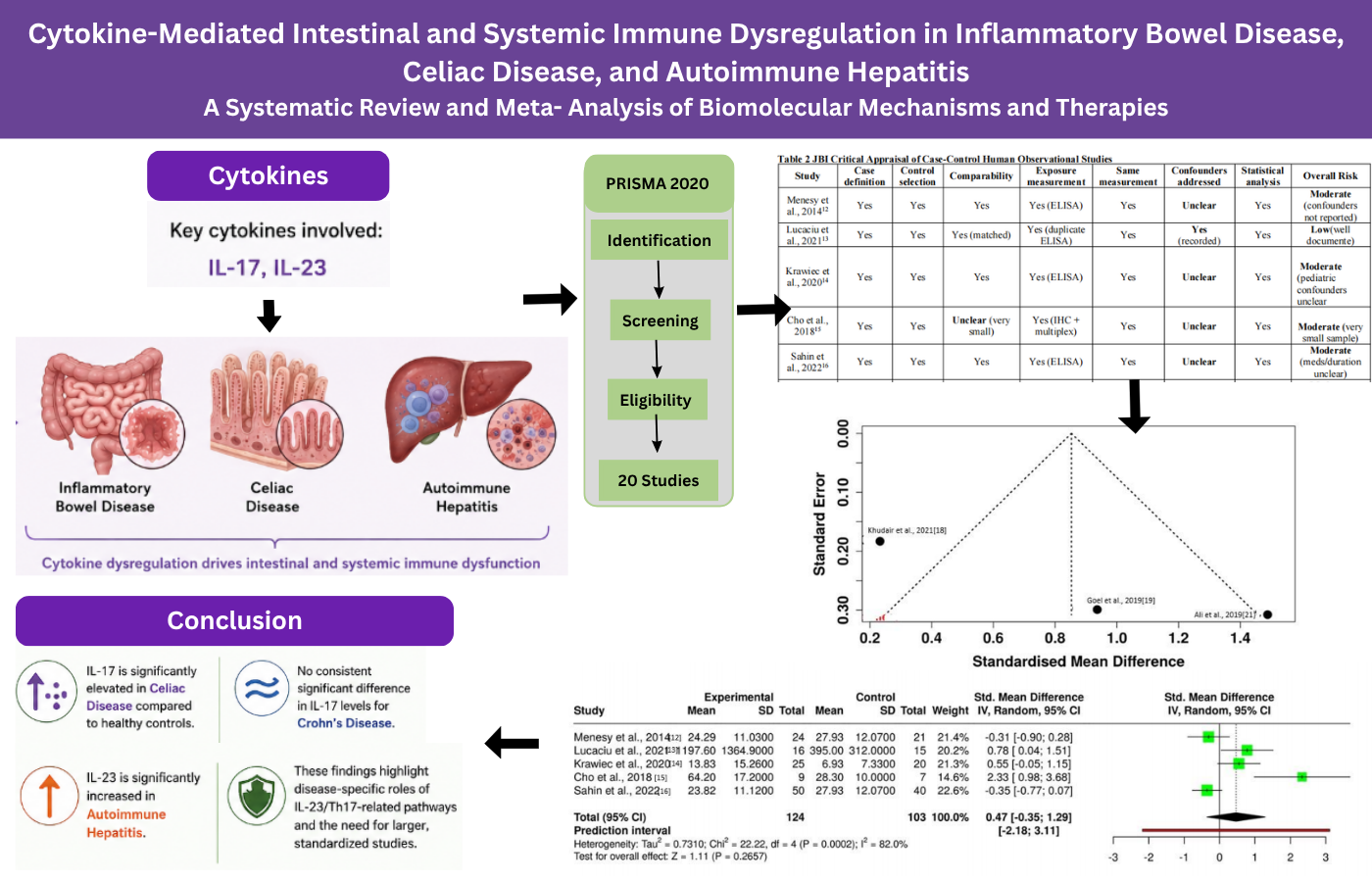
Background: Cytokine-mediated immune dysregulation is important in the pathogenesis of autoimmune and inflammatory diseases, such as inflammatory bowel disease, celiac disease, and autoimmune hepatitis. This paper set out to undertake a systematic review of cytokine-mediated immune mechanisms, especially the IL-17, in these conditions.
Methods: PRISMA 2020 was used in this systematic review. Up to March 2026, the electronic databases such as PubMed, Scopus, Web of Science, and Google Scholar were searched. Articles that reported cytokine levels or immune biomarkers in patients with inflammatory bowel disease, celiac disease, or autoimmune hepatitis versus those without any disease or animal studies, reviews, case reports, and studies of which quantitative cytokine levels were not measured were excluded. The synthesis of data was done qualitatively and quantitatively and meta-analysis was done on the synthesized data using random-effects model to estimate pooled standardized mean differences.
Results: 443 articles were found, out of which 15 articles were eligible to include in the systematic review, and a subset of them was added to the meta-analysis. The combined findings showed very high levels of circulating IL-17 in celiac disease patients in comparison with healthy controls, but no significant differences were found between Crohn disease patients and autoimmune hepatitis patients. In a number of the observational studies, the risk of bias was moderate and was assessed.
Conclusion: IL-17–mediated immune dysregulation is significantly elevated in celiac disease but not consistently in Crohn’s disease or autoimmune hepatitis, while IL-23 significantly increased in autoimmune hepatitis. These findings highlight disease-specific roles of IL-23/Th17-related pathways and the need for larger, standardized studies.
References
1. Vuyyuru SK, Kedia S, Sahu P, Ahuja V. Immune-mediated inflammatory diseases of the gastrointestinal tract: Beyond Crohn's disease and ulcerative colitis. JGH Open. 2022;6(2):100-111. https://doi.org/10.1002/jgh3.12706
2. Heneghan MA, Yeoman AD, Verma S, Smith AD, Longhi MS. Autoimmune hepatitis. Lancet. 2013;382(9902):1433-44. https://doi.org/10.1016/S0140-6736(12)62163-1
3. Monteleone I, Pallone F, Monteleone G. Interleukin-23 and Th17 cells in the control of gut inflammation. Mediators Inflamm. 2009;2009:297645. https://doi.org/10.1155/2009/297645
4. Bedoya SK, Lam B, Lau K, Larkin J. Th17 cells in immunity and autoimmunity. Clin Dev Immunol. 2013;2013:986789. https://doi.org/10.1155/2013/986789
5. Longhi MS, Mieli-Vergani G, Vergani D. Regulatory T cells in autoimmune hepatitis: an updated overview. J Autoimmun. 2021;119:102619. https://doi.org/10.1016/j.jaut.2021.102619
6. Shen L, Tso P, Wang DQH, Woods SC, Davidson WS, Sakai R, et al. Up-regulation of apolipoprotein E by leptin in the hypothalamus of mice and rats. Physiol Behav. 2009;98(1-2):223-228. https://doi.org/10.1016/j.physbeh.2009.05.013
7. Neurath MF. Cytokines in inflammatory bowel disease. Nat Rev Immunol. 2014;14(5):329-342. https://doi.org/10.1038/nri3661
8. Page MJ, McKenzie JE, Bossuyt PM, Boutron I, Hoffmann TC, Mulrow CD, et al. The PRISMA 2020 statement: an updated guideline for reporting systematic reviews. BMJ. 2021;372. https://doi.org/10.1136/bmj.n71
9. Sterne JAC, Savović J, Page MJ, Elbers RG, Blencowe NS, Boutron I, et al. RoB 2: a revised tool for assessing risk of bias in randomised trials. BMJ. 2019;366. https://doi.org/10.1136/bmj.l4898
10. Barker TH, Stone JC, Sears K, Klugar M, Tufanaru C, Leonardi-Bee J, et al. Revising the JBI quantitative critical appraisal tools to improve their applicability: an overview of methods and the development process. JBI Evid Synth. 2023;21(3):478-93. https://doi.org/10.11124/JBIES-22-00125
11. Menesy A, Hammad M, Aref S, Abozeid FAM. Level of interleukin 17 in inflammatory bowel disease and its relation with disease activity. BMC Gastroenterol. 2024;24:135. https://doi.org/10.1186/s12876-024-03218-7
12. Lucaciu LA, Ilieș M, Vesa ȘC, Seicean R, Din S, Iuga CA, et al. Serum interleukin (IL)-23 and IL-17 profile in inflammatory bowel disease patients could differentiate between severe and non-severe disease. J Pers Med. 2021;11(11):1130. https://doi.org/10.3390/jpm11111130
13. Krawiec P, Pac-Kożuchowska E. Serum interleukin 17A and interleukin 17F in children with inflammatory bowel disease. Sci Rep. 2020;10:12617. https://doi.org/10.1038/s41598-020-69567-x
14. Cho J, Kim S, Yang DH, Lee J, Park KW, Go J, Hyun CL, et al. Mucosal immunity related to FOXP3+ regulatory T cells, Th17 cells and cytokines in pediatric inflammatory bowel disease. J Korean Med Sci. 2018;33(52). https://doi.org/10.3346/jkms.2018.33.e336
15. Sahin A, Calhan T, Cengiz M, Kahraman R, Aydin K, Ozdil K, et al. Serum interleukin 17 levels in patients with Crohn's disease: real life data. Dis Markers. 2014;2014:690853. https://doi.org/10.1155/2014/690853
16. Madi M, Abdelsalam M, Elakel A, Zakaria O, AlGhamdi M, Alqahtan M, et al. Salivary interleukin-17A and interleukin-18 levels in patients with celiac disease and periodontitis. PeerJ. 2024;12. https://doi.org/10.7717/peerj.17374
17. Khudair FA, Aldeen TS. Role of IL-17a in the pathogenesis of celiac disease: a case-control study. Kufa Medical Journal. 2025;21(1). https://doi.org/10.36330/kmj.v21.i1.19296
18. Goel G, Daveson AJM, Hooi CE, Tye-Din JA, Wang S, Szymczak E, et al. Serum cytokines elevated during gluten-mediated cytokine release in coeliac disease. Clin Exp Immunol. 2019;199(1):68-78. https://doi.org/10.1111/cei.13369
19. Nafari M, Asri N, Rostami-Nejad M, Forouzesh F, Ehsani-Ardakani MJ, Jahani-Sherafat S, et al. Elevated interleukin-17A levels despite reduced microRNA-326 gene expression in celiac disease patients under gluten-free diet. Rom J Intern Med. 2022;60(3):166-172. https://doi.org/10.2478/rjim-2022-0011
20. Ali EN, Haphed NS, Alkhafaji AH, Thajeel RF, Farhan LI. Evaluation of serum levels of IL-12 and IL-17A in Iraqi patients infected with celiac disease. Biochem Cell Arch. 2019;19(2):3325-3327. https://doi.org/10.35124/bca.2019.19.2.3325
21. Gutkowski K, Gutkowska D, Kiszka J, Partyka M, Kacperek-Hartleb T, Kajor M, et al. Serum interleukin-17 levels predict inflammatory activity in patients with autoimmune hepatitis. Pol Arch Intern Med. 2018;128(3):150-156. https://doi.org/10.20452/pamw.4188
22. Thomas-Dupont P, Remes-Troche JM, Izaguirre-Hernández IY, Sánchez-Vargas LA, Maldonado-Rentería MJ, Hernández-Flores KG, et al. Elevated circulating levels of IL-21 and IL-22 define a cytokine signature profile in type 2 autoimmune hepatitis patients. Ann Hepatol. 2016;15(4):550-558. https://doi.org/10.5604/16652681.1203152
23. Miao X, Feng J, Yang A, Gao L, Peng X, Jiang N, et al. Th17/Treg balance and factors related to autoimmune hepatitis. Rheumatol Autoimmun. 2022;2(1):221-229. https://doi.org/10.1002/rai2.12047
24. Wang L, Du H, Liu Y, Wang L, Ma X, Zhang W, et al. Chinese medicine Bu Xu Hua Yu recipe for the regulation of Treg/Th17 ratio imbalance in autoimmune hepatitis. Evid Based Complement Alternat Med. 2015;2015:461294. https://doi.org/10.1155/2015/461294
25. Zhao L, Tang Y, You Z, Wang Q, Liang S, Han X, et al. Interleukin-17 contributes to the pathogenesis of autoimmune hepatitis through inducing hepatic interleukin-6 expression. PLoS One. 2011;6(4). https://doi.org/10.1371/journal.pone.0018909
26. Fujino S, Andoh A, Bamba S, Ogawa A, Hata K, Araki Y, et al. Increased expression of interleukin 17 in inflammatory bowel disease. Gut. 2003;52(1):65-70. https://doi.org/10.1136/gut.52.1.65
27. Wan X, Wang W, Liu J, Tong T. Estimating the sample mean and standard deviation from the sample size, median, range and/or interquartile range. BMC Med Res Methodol. 2014;14:135. https://doi.org/10.1186/1471-2288-14-135
28. Monteleone I, Sarra M, Del Vecchio Blanco G, Paoluzi OA, Franzè E, Fina D, et al. Characterization of IL-17A-producing cells in celiac disease mucosa. J Immunol. 2010;184(4):2211-2218. https://doi.org/10.4049/jimmunol.0901919
29. Monteleone I, Sarra M, Del Vecchio Blanco G, Paoluzi OA, Franzè E, Fina D, et al. Characterization of IL-17A-producing cells in celiac disease mucosa. J Immunol. 2010;184(4):2211-2218. https://doi.org/10.4049/jimmunol.0901919
30. Kuwabara T, Ishikawa F, Kondo M, Kakiuchi T. The role of IL-17 and related cytokines in inflammatory autoimmune diseases. Mediators Inflamm. 2017;2017:3908061. https://doi.org/10.1155/2017/3908061
31. Ruiz de Morales JMG, Puig L, Daudén E, Cañete JD, Pablos JL, Olveira Martín A, et al. Critical role of interleukin (IL)-17 in inflammatory and immune disorders: an updated review of the evidence focusing in controversies. Autoimmun Rev. 2020;19(1):102429. https://doi.org/10.1016/j.autrev.2019.102429
32. Veny M, Esteller M, Ricart E, Piqué JM, Panés J, Salas A. Late Crohn's disease patients present an increase in peripheral Th17 cells and cytokine production compared with early patients. Aliment Pharmacol Ther. 2010;31(5):561-72. https://doi.org/10.1111/j.1365-2036.2009.04209.x
33. Jiang W, Su J, Zhang X, Cheng X, Zhou J, Shi R, et al. Elevated levels of Th17 cells and Th17-related cytokines are associated with disease activity in patients with inflammatory bowel disease. Inflamm Res. 2014;63(11):943-50. https://doi.org/10.1007/s00011-014-0768-7
34. Atreya R, Neurath MF. Current and future targets for mucosal healing in inflammatory bowel disease. Visc Med. 2017;33(1):82-88. https://doi.org/10.1159/000458006
35. Abe M, Hiasa Y, Onji M. T helper 17 cells in autoimmune liver diseases. Clin Dev Immunol. 2013;2013:607073. https://doi.org/10.1155/2013/607073
36. Whiteside TL. Cytokine measurements and interpretation of cytokine assays in human disease. J Clin Immunol. 1994;14(6):327-39. https://doi.org/10.1007/BF01546317
37. Liu C, Chu D, Kalantar-Zadeh K, George J, Young HA, Liu G. Cytokines: from clinical significance to quantification. Adv Sci (Weinh). 2021;8(15):2004433. https://doi.org/10.1002/advs.202004433
38. Moher D, Liberati A, Tetzlaff J, Altman DG; PRISMA Group. Preferred reporting items for systematic reviews and meta-analyses: the PRISMA statement. PLoS Med. 2009;6(7). https://doi.org/10.1371/journal.pmed.1000097
39. Califf RM. Biomarker definitions and their applications. Exp Biol Med (Maywood). 2018;243(3):213-221. https://doi.org/10.1177/1535370217750088
40. Riley RD, Debray TPA, Fisher D, Hattle M, Marlin N, Hoogland J, et al. Individual participant data meta-analysis to examine interactions between treatment effect and participant-level covariates: statistical recommendations for conduct and planning. Stat Med. 2020;39(15):2115-2137. https://doi.org/10.1002/sim.8516
41. Liu X, Chen L, Peng W, Deng H, Ni H, Tong H, et al. Th17/Treg balance: the bloom and wane in the pathophysiology of sepsis. Front Immunol. 2024;15:1356869. https://doi.org/10.3389/fimmu.2024.1356869
Downloads
Published
Issue
Section
License
Copyright (c) 2026 Asmat Ullah Khan, Hina Murtaza, Raheela Khawar (Author)

This work is licensed under a Creative Commons Attribution-NonCommercial 4.0 International License.
Al-Najam Journal of Medical and Life Sciences (ANJMLS) follows the Attribution Creative Commons-Non commercial (CC BY-NC) license which allows the users to copy and redistribute the material in any medium or format, remix, transform and build upon the material. The users must give credit to the source and indicate, provide a link to the license, and indicate if changes were made. However, the CC BY-NC license restricts the use of material for commercial purposes (Further details are available at website. The Editorial Board of the ANJMLS endeavors to ensure the accuracy, integrity, and quality of all published content. However, the responsibility of opinions, interpretations, and conclusions expressed in the published articles rests entirely with the authors and do not necessarily reflect the views of the Editorial Board, publisher, or affiliated institutions.