Patterns of Post-COVID Symptoms Among Recovered Patients Attending Follow-Up Clinics, A cross-sectional analysis
Keywords:
Post-COVID syndrome, symptom burden, COVID-19 recovery, follow-up clinics, cross-sectional analysisAbstract
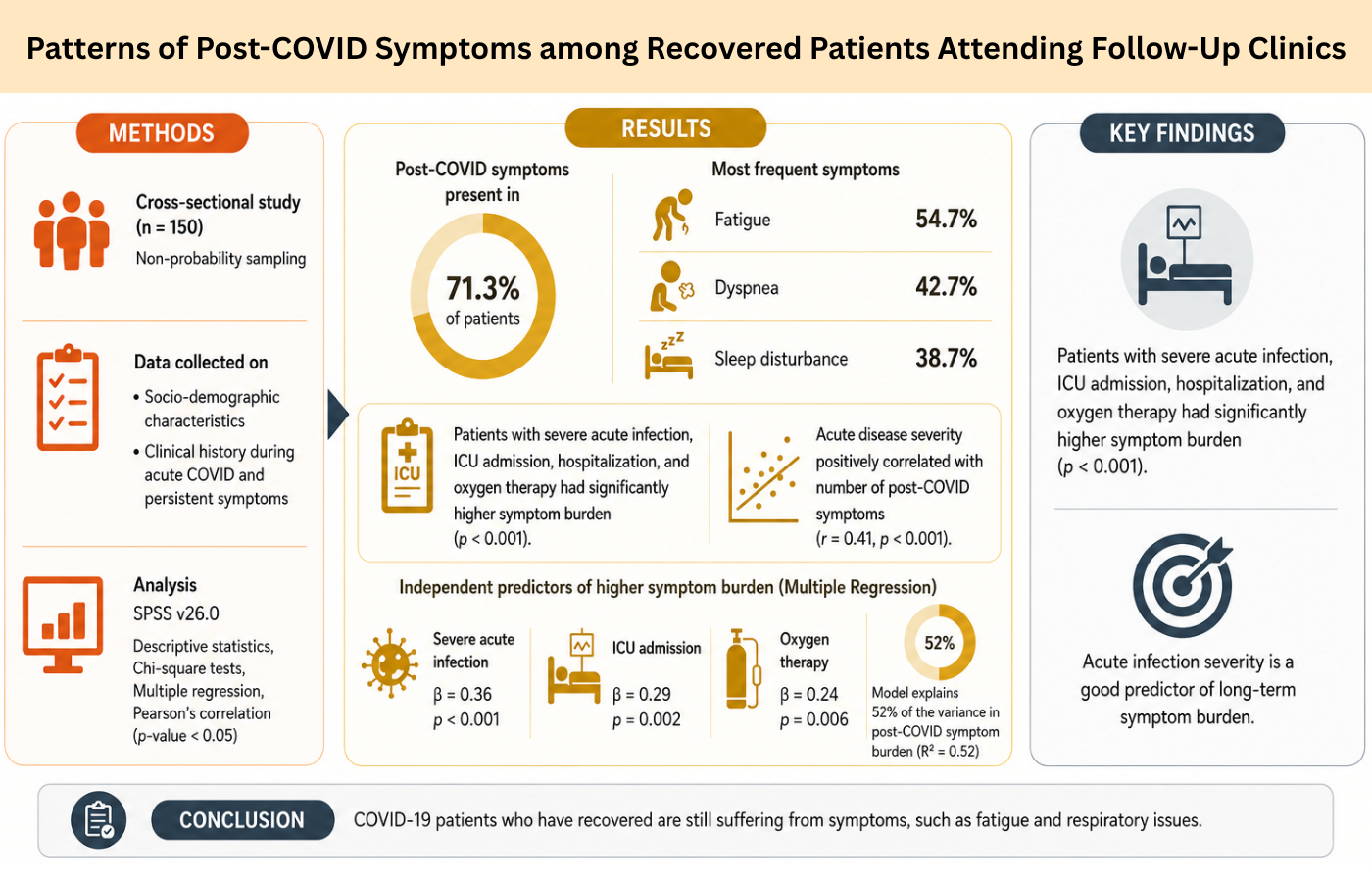
Background: Post-COVID syndrome is a serious public health problem that is caused by persisting symptoms after the acute phase of SARS-CoV-2 infection. The study aimed to evaluate the symptom pattern of recovered patients in follow-up clinics and to classify factors related with the burden of symptoms. Methods: A cross-sectional study (n=150) used non-probability technique to gather data on socio-demographic characteristics, clinical history during persistent symptoms of COVID and acute COVID infection. SPSS version 26.0, data analysis was carried out. Descriptive statistics, chi-squared tests, multiple regression analysis and Pearson's correlation were performed to identify associations between variables (p-value < 0.05). Results: COPD symptoms were present in 71.3% of patients and the most repeated symptoms were fatigue (54.7%), dyspnea (42.7%) and sleep disturbance (38.7%). Patients with severe acute infection, ICU admission, hospitalization, oxygen therapy and significantly had more symptoms burden (p < 0.001). The acute disease severity positively and significantly correlated with number of post-COVID symptoms (r = 0.41, p<0.001). Severe acute infection (β = 0.36, p < 0.001), intensive care unit (ICU) admission (β = 0.29, p = 0.002), and oxygen therapy (β = 0.24, p = 0.006) were found to be significant factors in predicting a higher symptom burden. The model explained 52% of the variance in the post-COVID symptom burden (R² = 0.52). Conclusions: COVID-19 patients who have recovered are still suffering from symptoms, such as fatigue and respiratory issues. Acute infection severity is a good predictor of long-term symptom burden.
References
1. Hao YJ, Wang YL, Wang MY, Zhou L, Shi JY, Cao JM, et al. The origins of COVID-19 pandemic: A brief overview. Transbound Emerg Dis. 2022 Nov;69(6):3181-3197. https://:doi.org/10.1111/tbed.14732
2. Contini C, Di Nuzzo M, Barp N, Bonazza A, De Giorgio R, Tognon M, et al. The novel zoonotic COVID-19 pandemic: An expected global health concern. J Infect Dev Ctries. 2020 Mar 31;14(3):254-264. https://:doi.org/10.3855/jidc.12671
3. Davoudi F, Miyashita S, Yoo TK, Lee PT, Foster GP. An Insight Into Pathophysiology, Epidemiology, and Management of Cardiovascular Complications of SARS-CoV-2 Infection, Post-acute COVID Syndrome, and COVID Vaccine. Crit Pathw Cardiol. 2022 Sep 1;21(3):123-129. https://:doi.org/10.1097/HPC.0000000000000290
4. Pavli A, Theodoridou M, Maltezou HC. Post-COVID Syndrome: Incidence, Clinical Spectrum, and Challenges for Primary Healthcare Professionals. Arch Med Res. 2021 Aug;52(6):575-581. https://doi.org/10.1016/j.arcmed.2021.03.010
5. Maltezou HC, Pavli A, Tsakris A. Post-COVID Syndrome: An Insight on Its Pathogenesis. Vaccines (Basel). 2021 May 12;9(5):497. https://doi.org/10.3390/vaccines9050497
6. Elseidy SA, Awad AK, Vorla M, Fatima A, Elbadawy MA, Mandal D, et al. Cardiovascular complications in the Post-Acute COVID-19 syndrome (PACS). Int J Cardiol Heart Vasc. 2022 Mar 28;40:101012. https://doi.org/10.1016/j.ijcha.2022.101012
7. Van Herck M, Goërtz YMJ, Houben-Wilke S, Machado FVC, Meys R, Delbressine JM, et al. Severe Fatigue in Long COVID: Web-Based Quantitative Follow-up Study in Members of Online Long COVID Support Groups. J Med Internet Res. 2021 Sep 21;23(9):e30274. https://doi.org/10.2196/30274
8. Carod-Artal FJ. Post-COVID-19 syndrome: epidemiology, diagnostic criteria and pathogenic mechanisms involved. Rev Neurol. 2021 Jun 1;72(11):384-396. English, Spanish. https://doi.org/10.33588/rn.7211.2021230
9. Schwarz T, Schmidt AE, Bobek J, Ladurner J. Barriers to accessing health care for people with chronic conditions: a qualitative interview study. BMC Health Serv Res. 2022 Aug 14;22(1):1037. https://doi.org/10.1186/s12913-022-08426-z
10. Aldhawyan AF, BuSaad MA, Alamri BA, Alsaihati MI, Alanazi BS, Alanazi RA, et al. Evaluating the Predictors of Persistent Long COVID Symptoms and Their Severity in COVID-19 Survivors 1 Year After Infection. J Prim Care Community Health. 2024 Jan-Dec;15:21501319241295686. https://doi.org/10.1177/21501319241295686
11. Alkhormani AA, Alghamdi RA, Damdam YA, Almaghrabi ME, Alamri FF, Khan MA, et al. Post-COVID-19 manifestations among college students: shedding the light on young adults' health. BMC Public Health. 2024 Dec 30;24(1):3613. https://doi.org/10.1186/s12889-024-20925-8.
12. Khodeir MM, Shabana HA, Rasheed Z, Alkhamiss AS, Khodeir M, Alkhowailed MS, et al. COVID-19: Post-recovery long-term symptoms among patients in Saudi Arabia. PLoS One. 2021 Dec 8;16(12):e0260259. https://doi.org/10.1371/journal.pone.0260259
13. Chan Sui Ko A, Candellier A, Mercier M, Joseph C, Schmit JL, Lanoix JP, et al. Number of initial symptoms is more related to long COVID-19 than acute severity of infection: a prospective cohort of hospitalized patients. Int J Infect Dis. 2022 May;118:220-223. https://doi.org/10.1016/j.ijid.2022.03.006
14. Luo S, Lai LY, Zhu R, Gao Y, Zhao Z. Prevalence and duration of common symptoms in people with long COVID: a systematic review and meta-analysis. J Glob Health. 2025 Oct 17;15:04282. https://doi.org/10.7189/jogh.15.04282
15. Tleyjeh IM, Saddik B, AlSwaidan N, AlAnazi A, Ramakrishnan RK, Alhazmi D, et al. Prevalence and predictors of Post-Acute COVID-19 Syndrome (PACS) after hospital discharge: A cohort study with 4 months median follow-up. PLoS One. 2021 Dec 7;16(12):e0260568. https://doi.org/10.1371/journal.pone.0260568
16. AlShamrani M, Farahat F, Assiri A, AlHajjar S, Albarrak A, AlHashemi H, et al. Consensus based recommendations for the management of post-COVID long-term sequelae (Long COVID): a regional perspective. Front Med (Lausanne). 2025 Aug 6;12:1453167. https://doi.org/10.3389/fmed.2025.1453167
17. Rahmati M, Udeh R, Kang J, Dolja-Gore X, McEvoy M, Kazemi A, et al. Long-Term Sequelae of COVID-19: A Systematic Review and Meta-Analysis of Symptoms 3 Years Post-SARS-CoV-2 Infection. J Med Virol. 2025 Jun;97(6):e70429. https://doi.org/10.1002/jmv.70429
18. Lee E, Ozigbo AA, Varon J, Halma M, Laezzo M, Ang SP, et al. Mitochondrial Reactive Oxygen Species: A Unifying Mechanism in Long COVID and Spike Protein-Associated Injury: A Narrative Review. Biomolecules. 2025 Sep 18;15(9):1339. https://doi.org/10.3390/biom15091339
19. Sampol J, Miravitlles M, Sáez M, Pallero M, Sampol G, Ferrer J. Poor sleep quality, COPD severity and survival according to CASIS and Pittsburgh questionnaires. Sci Rep. 2023 Oct 31;13(1):18656. https://doi.org/10.1038/s41598-023-45717-9
20. Ghalehbandi M, Khosravifar S, Aloosh O, Rahimi-Golkhandan A, Abounoori M, Aloosh A, et al. The association between sleep quality, health status and disability due to breathlessness in chronic obstructive pulmonary disease patients. Clin Respir J. 2021 Nov;15(11):1168-1174. https://doi.org/10.1111/crj.13423
21. Negrut N, Menegas G, Kampioti S, Bourelou M, Kopanyi F, Hassan FD, et al. The Multisystem Impact of Long COVID: A Comprehensive Review. Diagnostics (Basel). 2024 Jan 24;14(3):244. https://doi.org/10.3390/diagnostics14030244
22. Yeetho P, Chaiviboontham S, Sumdaengrit B. The relationships between symptom severity post COVID-19, stress, social support and adaptation in patients with COVID-19 after discharge from the hospital. PLoS One. 2025 Nov 3;20(11):e0327825. https://doi.org/10.1371/journal.pone.0327825
23. Korompoki E, Gavriatopoulou M, Hicklen RS, Ntanasis-Stathopoulos I, Kastritis E, Fotiou D, et al. Epidemiology and organ specific sequelae of post-acute COVID19: A narrative review. J Infect. 2021 Jul;83(1):1-16. https://doi.org/10.1016/j.jinf.2021.05.004
24. Ballouz T, Menges D, Anagnostopoulos A, Domenghino A, Aschmann HE, Frei A, et al. Recovery and symptom trajectories up to two years after SARS-CoV-2 infection: population based, longitudinal cohort study. BMJ. 2023 May 31;381:e074425. https://doi.org/10.1136/bmj-2022-074425
25. Setareh M, Alavi NM, Atoof F. Severity of illness affecting the length of stay and outcomes in patients admitted to intensive care units, Iran, 2019. J Educ Health Promot. 2021 May 20;10:142. https://doi.org/10.4103/jehp.jehp_780_20
26. Del Corral T, Fabero-Garrido R, Plaza-Manzano G, Izquierdo-García J, López-Sáez M, García-García R, et al. Effect of respiratory rehabilitation on quality of life in individuals with post-COVID-19 symptoms: A randomised controlled trial. Ann Phys Rehabil Med. 2025 Feb;68(1):101920. https://doi.org/10.1016/j.rehab.2024.101920
27. Rochester CL, Alison JA, Carlin B, Jenkins AR, Cox NS, Bauldoff G, et al. Pulmonary Rehabilitation for Adults with Chronic Respiratory Disease: An Official American Thoracic Society Clinical Practice Guideline. Am J Respir Crit Care Med. 2023 Aug 15;208(4):e7-e26. https://doi.org/10.1164/rccm.202306-1066ST
28. Weigl M, Beeck S, Kraft E, Stubbe HC, Adorjan K, Ruzicka M,et al. Multidisciplinary rehabilitation with a focus on physiotherapy in patients with Post Covid19 condition: an observational pilot study. Eur Arch Psychiatry Clin Neurosci. 2024 Dec;274(8):2003-2014. https://doi.org/10.1007/s00406-023-01747-y
Downloads
Published
Issue
Section
License
Copyright (c) 2026 Attiya Khizar, Shahida Anjum, Momina Rehmat (Author)

This work is licensed under a Creative Commons Attribution-NonCommercial 4.0 International License.
Al-Najam Journal of Medical and Life Sciences (ANJMLS) follows the Attribution Creative Commons-Non commercial (CC BY-NC) license which allows the users to copy and redistribute the material in any medium or format, remix, transform and build upon the material. The users must give credit to the source and indicate, provide a link to the license, and indicate if changes were made. However, the CC BY-NC license restricts the use of material for commercial purposes (Further details are available at website. The Editorial Board of the ANJMLS endeavors to ensure the accuracy, integrity, and quality of all published content. However, the responsibility of opinions, interpretations, and conclusions expressed in the published articles rests entirely with the authors and do not necessarily reflect the views of the Editorial Board, publisher, or affiliated institutions.