Hafsa Aslam1*
1Center of Excellence in Molecular Biology, University of the Punjab, Lahore, Pakistan
*Correspondence: Hafsa Aslam (hafsaaslam35102@gmail.com)
Received: 11 February, 2026; Revised: 01 March, 2026; Accepted: 06 March, 2026; Published: 10 March, 2026
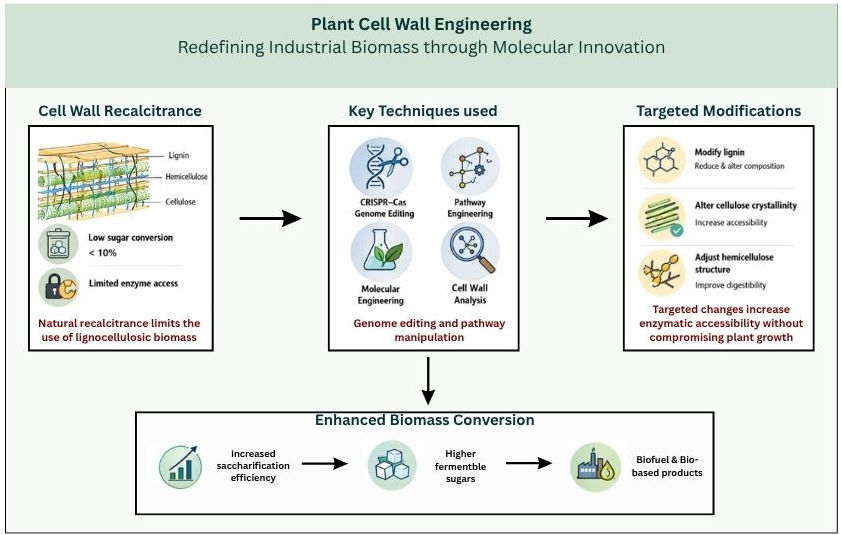
Biomass, particularly lignocellulosic biomass, a promising renewable energy source in the production of biofuel and bio-based products, but its effective use is limited due to the cell wall recalcitrance. The intricate structure of the plant cell wall limits the enzymatic accessibility, which leads to the low conversion efficiency of less than 10% into fermentable sugars. Recent developments in molecular and genetic engineering, especially the CRISPR-Cas based genome editing and pathway manipulation, have enabled the targeted modifications of the cell wall components. Experimental results show that modifications of lignin biosynthesis and composition have the potential to increase saccharification efficiency without causing growth penalties. Cellulose crystallinity and hemicellulose structure modifications can enhance the digestibility of biomass. This review critically discusses the molecular basis of cell wall recalcitrance, recent experimental approaches to reduce the recalcitrance, and evaluates their industrial relevance in enhancing biomass conversion efficiency.
Keywords: Lignocellulosic biomass, Cell wall recalcitrance, Saccharification efficiency, Lignin biosynthesis, CRISPR/Cas9, Biomass engineering
Global energy transition towards sustainable energy and bio-based industrial systems has increased the need to maximize the use of lignocellulosic biomass as a renewable feedstock. The plant cell wall, which is mainly composed of cellulose, hemicellulose, and lignin, constitutes the largest terrestrial carbon storage. However, their structural complexity and recalcitrance pose a major limitation to efficient industrial processing. It is estimated that <10% of lignocellulosic biomass is converted into fermentable sugars due to resistance to enzymatic hydrolysis, despite its abundance 1. Latest advancements in molecular biology, especially genome editing and pathway engineering, have enabled modifications to the cell wall structure. The purpose of these advancements is to reduce biomass recalcitrance by adjusting lignin composition, cellulose crystallinity, and hemicellulose interactions, enhancing the saccharification efficiency and industrial feasibility 2.
CRISPR-Cas9 Mediated Lignin Pathway Engineering: Lignin is the major barrier to effective biomass conversion because of its cross-linked and hydrophobic phenolic structure. Recent CRISPR-Cas9 based methods have allowed targeted knockout of genes involved in lignin biosynthetic pathways, e.g., CAD and COMT, leading to controlled alterations in lignin composition and accumulation 3. Bioenergy Crops mutated by CRISPR-Cas have shown a 20%-30% reduction in lignin with 30%-50% increased saccharification efficiency without any morphological abnormalities 4. These changes also affect the syringyl/guaiacyl (S/G) ratio, which enhances the accessibility of enzymes. Mechanically, disruption of genes leads to the alteration of monolignol biosynthesis and polymer assembly, which produces a less condensed lignin web that is more susceptible to chemical and enzymatic breakdown 5. Targeted lignin engineering has a high level of industrial relevance, as even a moderate reduction in lignin content has a considerable impact on reducing the severity of pretreatment processes and processing cost.
Cellulose Microfibril Reorganization via Cellulose Synthase (CesA) Engineering: The crystallinity of cellulose is one of the key parameters that defines the digestibility of biomass since tightly packed microfibrils limit the accessibility of enzymes. Cellulose synthase (CesA) complex engineering has become an efficient approach to alter cellulose structure at the molecular scale 6. Recent reports have demonstrated that a 10%-15% decrease in crystallinity of cellulose can increase the efficiency of enzymatic hydrolysis by up to 35%, with higher glucose yields during biomass conversion 7. This is done by mutating CesA subunits, which modify the glucan chain assembly and microfibril organization. Additionally, the synchronous control of cellulose biosynthesis with other cell wall materials increases structural flexibility, enabling enzyme penetration. Such results indicate that manipulation of cellulose structure, as opposed to decreasing its concentration, is a better approach to preserving biomass production and enhancing industrial processing performance.
Hemicellulose Remodelling through Xylan Deacetylation Strategies: Hemicellulose, particularly xylan, plays a crucial role in cross-linking cellulose and lignin, contributing to overall cell wall rigidity and recalcitrance. Xylan acetylation prevents enzymatic hydrolysis and produces fermentation inhibitors during pretreatment processes 8. Biomass processing has been improved significantly through genetic engineering methods targeting acetylation pathways. Saccharification efficiency has increased up to 40%-50% by reducing xylan acetylation levels 9. This improves enzymatic digestibility and downstream fermentation performance. Structurally, reduced acetylation undermines hemicellulose-cellulose interactions, leading to a more open and accessible cell wall matrix. These alterations are beneficial to minimize pretreatment expenses, which consume almost a one-third of the total cost of biofuels production.
Designer Lignin Engineering via Monolignol Conjugation (Zip-Lignin Technology): Another breakthrough in the plant cell wall engineering is the development of “designer lignin”, which creates chemically labile bonds between the lignin polymers. This is done by expressing monolignol ferulate transferase to incorporate ester linkages in the lignin backbone 10. This method does not decrease the lignin content; instead, it alters the chemical properties of lignin. Under mild pretreatment conditions, engineered plants can release up to 2-fold sugar, which is a significant enhancement of biomass deconstruction efficiency 11. The selective cleavage of lignin in the processing process without affecting the growth of plants is a significant breakthrough in biomass engineering.
Systems-Level and Multi-Omics Engineering for Industrial Biomass Optimization: New developments in systems biology have made it possible to combine multi-gene modifications to target lignin, cellulose, and hemicellulose simultaneously. Multi-omics techniques, such as transcriptomics and metabolomics, give an understanding of how the intricate regulation governs networks of cell wall biosynthesis 12. Stacked genetic modifications have shown a positive synergistic outcome, as the total sugar yield has improved more than single-gene modification 13. Moreover, the optimization of carbon flux to desired components of the cell wall can be done by pathway-level engineering, improving the biomass quality and industrial efficiency. These approaches are now being implemented on bioenergy crops, facilitating the establishment of the next-generation feedstocks tailored for biorefineries.
Industrial Implications and Future Perspectives: The usage of molecular innovations in the engineering of the plant cell wall has great potential in biofuels production and in the biorefinery sectors. Improved biomass digestibility will minimize 20%-30% processing cost, which will make the lignocellulosic biofuels more economical than fossil fuels 14. In addition, engineered biomass is used in the manufacturing of high-value biochemicals, bioplastics, and advanced biofuels, increasing the range of sustainable industrial applications. Future studies focusing on precise genome editing, synthetic biology, and AI-controlled optimization of pathways are likely to improve the biomass design 15.
Conclusion: Plant cell wall engineering is one of the potent ways of overpowering the inherent recalcitrance of lignocellulosic biomass. Specific molecular innovations, like CRISPR-based lignin modification, cellulose synthase engineering, hemicellulose remodelling, and designer lignin generation, can improve the efficiency of biomass processing. These developments not only enhance biofuel production but also lower the industrial expenses and environmental effects. With the further development of systems-level and multi-gene engineering methods, the rational design of plant cell walls will be of primary importance in the development of sustainable bio-based industries.

AL-NAJAM Journal of Medical and Life Sciences, Al Najam J Med Life Sci 2026:1(1), p51-53 (anjmls.org) © 2026 Authors. This work is published by Multidisciplinary Scholarly Advancement and Research MSAR Institute. The full terms of Journal Publishing policy is available at https://anjmls.com/index.php/anjmls/publishing-license and incorporate the Creative Commons Attribution – Non Commercial (CC BY, NC 4.0) License https://creativecommons.org/licenses/by-nc/4.0/. By accessing the work you hereby accept the Terms. Non-commercial uses of the work are permitted without any further permission, provided the work is properly attributed. Publisher’s Note: MSAR Institute remains neutral with regard to jurisdictional claims in published maps and institutional affiliations, and assumes no liability for the scientific accuracy or clinical efficacy of the content herein, as they rest entirely with the authors.