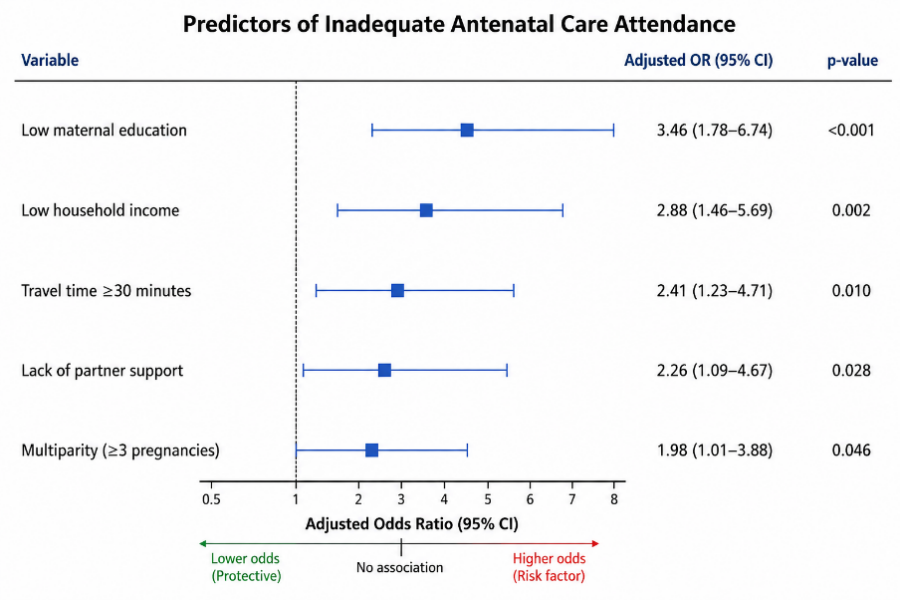
Figure 1: Forest plot of predictors of inadequate antenatal care attendance.
Muneera Ehsan1 | Komal Anayat1 | Shazia Ahmed2* | Fatima Mubeen Ali2
1Department of Allied Health Sciences, Government College University, Faisalabad, Pakistan | 2Department of Allied Health Sciences, Superior University, Lahore, Pakistan
*Correspondence: Shazia Ahmed (shaziamedicalsc@gmail.com)
Received: 07 August, 2026; Revised: 09 September, 2026; Accepted: 12 September, 2026; Published: 20 September, 2026
Background: ANC (Antenatal Care) services can help identify and manage early pregnancy risks and provide access to essential preventive and counseling services. The objective of this study was to evaluate ANC visit attendance, visit timing and quality, and factors associated with poor attendance among pregnant women. Methods: This study comprised 210 pregnant women attending the antenatal clinic, who were interviewed using a structured questionnaire, which included items related to sociodemographic characteristics, obstetric history, household income, access to health services, partner's support, and ANC utilization. Data were analysed with SPSS version 26.0. Chi-square or Fisher's exact tests were used for the assessment of associations, subsequently analyzed by multivariable logistic regression. Results: Overall, 144 women (68.6%) attended four or more ANC visits, while 66 women (31.4%) attended fewer than four ANC visits. 128 women (61.0%) reported being registered for a first-trimester pregnancy. Financial limitations (28.8%) and out-of-the-way distance to the health facility (24.2%) were the most common obstacles reported. In multivariable analysis, low maternal education (AOR=3.46, 95% CI: 1.78–6.74; p<0.001), low household income (AOR=2.88, 95% CI: 1.46–5.69; p=0.002), travel time of at least 30 minutes (AOR=2.41, 95% CI: 1.23–4.71; p=0.010), lack of partner support (AOR=2.26, 95% CI: 1.09–4.67; p=0.028), and multiparity (AOR=1.98, 95% CI: 1.01–3.88; p=0.046) independently predicted inadequate attendance. Conclusions: Almost one-third of the participants did not attend the recommended minimum institutional visits for ANC. Enhanced maternal education, financial support, geographic access, and partner engagement can improve timely and sustained ANC attendance.
Keywords: Health Services Accessibility; Maternal Health Services; Pregnancy; Prenatal Care; Social Support; Socioeconomic Factors
Antenatal care (ANC) is one of the key aspects of maternal health care as it helps assess the health of both the mother and baby, detect pregnancy problems, provide preventive care, provide nutrition counseling, and prepare for childbirth and obstetric emergencies 1. Several screening and preventive interventions are best started in the first trimester, and early initiation is important 2. The current standards encourage the first contact within 12 weeks and at least 8 contacts, but 4 or more visits is a frequently used research indicator 3. A systematic review and meta-analysis of 145 studies in low- and middle-income countries (LMIC) showed that there were significant gaps in the continuity of care, with just 50.8% of women attaining four or more ANC visits 4,5.
There are individual, household, community, and health system factors that interact to influence ANC visits 6. Limited maternal education, poverty, rural living, transportation issues, long distance to travel, cultural barriers, negative provider attitudes, and long provider waiting times are all identified as significant barriers in recent systematic reviews 7. Household wealth, maternal and partner education, access to information, decision-making capacity, and partner or family support are conducive to timely and adequate attendance 8. Similar links between education, wealth, place of residence, birth order, pregnancy intention, treatment costs and distance from health facilities are also reported in studies of South Asians 9. Inequalities based on education, household wealth, parity and geographical access are also observed in Pakistan based on the available evidence 10. Despite the high coverage of ANC, the attendance rates and determinants of ANC do not seem to be similar across sites, and the results from the national surveys do not necessarily reflect the attendance of women at ANC at tertiary hospitals 11. Modifying factors, therefore, must be identified from context-specific evidence and targeted interventions made. This study provides context-specific evidence to identify gaps in ANC attendance and inform targeted improvements in maternal care.
The objective of this study was to determine the attendance rate of pregnant women at antenatal appointments at tertiary-level centers. It also sought to identify early registration and completion of at least four ANC visits. Lastly, it looked at factors independently associated with not attending adequate ANC visits.
A cross-sectional study was carried out in the facility setting to assess the trend of pregnant women's attendance for ANC and factors associated with the use of appropriate ANC among pregnant women. This study was conducted in an antenatal clinic in a tertiary-level government teaching hospital in Lahore for 6 months (April 2025- September 2025), with consecutive sampling of 210 pregnant women. The sample size was estimation as performed in OpenEpi version 3.0.0 (released 2013, Atlanta, GA, USA), using n = Z²P(1−P)/e² formula, where n denotes the required sample size, Z the standard normal deviate, P the expected prevalence, and e the margin of error, assuming a 50% prevalence of adequate ANC attendance, a 95% confidence level, and a 7% margin of error, with an additional allowance for potential non-response 12.
The women were included if they attended the antenatal clinic during the study period, irrespective of their gestation age, were aged 18 years and above, and gave written informed consent. Women with severe medical and/or psychiatric conditions and those who were referred for emergency obstetric management and those who did not have complete data from the interview were excluded. The data were collected through face-to-face interviews with the respondents using a pre-tested and structured questionnaire as recommended by the World Health Organization (WHO) for evaluating the ANC services. The questionnaire was comprised of maternal age, education, occupation, household income, place of residence, parity, gestational age, timing of the first antenatal visit, number of antenatal visits, availability of healthcare facilities, travel time, transportation, partner support, and previous obstetric history and teaching of maternal health during pregnancy. Antenatal data available included details of tetanus immunization, Iron–folic acid supplementation, counselling on nutrition, blood pressure monitoring, laboratory investigation, and ultrasound examination.
The study institution used the national maternal health care guidelines of 4 or more ANC visits to determine attendance at sufficient ANC. The women had fewer than 4 visits to antenatal care, which was defined as poor attendance of ANC. Individuals who had not attended the clinics regularly were also asked about the factors delaying timely attendance to the clinic, including financial problems, transportation challenges, household responsibilities, distance to the clinic, and lack of family support.
The data were initially entered into Microsoft Excel (Microsoft Corporation, Redmond, WA, USA) and analyzed using (SPSS) version 28.0 (IBM Corp., NY, USA). All the continuous variables were presented as mean ± SD and categorical variables as frequencies and percentages. The Chi-square test or Fisher's exact test was used to compare attendance for adequate and inadequate ANC. Bivariate analysis showed that there was a statistically significant association between inadequate ANC attendance and the variables, which were subsequently entered into a multivariable logistic regression model to determine independent predictors of inadequate antenatal care attendance. The odds ratios (ORs) were adjusted for the other variables included in the model and were presented with 95% confidence intervals (CIs); p-values < 0.05 (two-sided) were considered statistically significant. The study was approved by the Institutional Review Board before starting. According to the ethical principles of the Declaration of Helsinki, all the respondents provided confidential information in a voluntary and written informed manner, and it was preserved throughout the research process 13.
All 210 pregnant women at the obstetric services were recruited. The mean age of the mothers was 28.9 ± 5.8 years. Overall, 144 (68.6%) of women attended the recommended 4 or more antenatal visits, compared with women having inadequate ANC attendance of 66 (31.4%). 128 (61.0%) of the participants registered in the first trimester. ANC attendance was significantly associated with distance to health facilities, maternal education, partner support, and prior experience of pregnancy (p<0.05). Table I shows that fewer than adequate antenatal services were delivered. A large proportion of women received tetanus vaccination 183 (87.1%) and iron–folic acid supplementation 176 (83.8%), but nutritional counselling was only provided to 149 (71.0%) of women.
| ANC Characteristic | Frequency (n) | Percentage (%) |
|---|---|---|
| First ANC visit during first trimester | 128 | 61.0 |
| First ANC visit during second trimester | 61 | 29.0 |
| First ANC visit during third trimester | 21 | 10.0 |
| ≥4 ANC visits | 144 | 68.6 |
| <4 ANC visits | 66 | 31.4 |
| Received tetanus vaccination | 183 | 87.1 |
| Iron/Folic acid supplementation | 176 | 83.8 |
| Received nutrition counseling | 149 | 71.0 |
High education, high household income, urban living, and good partner support were all significantly related to good attendance in ANC (all p<0.01). Even though the association with employment status was not significant (p=0.068), the socioeconomic and family-related factors played more important roles in the use of healthcare services than employment status alone, as shown in Table II.
| Variable | ≥4 ANC Visits (n=144) | <4 ANC Visits (n=66) | p-value |
|---|---|---|---|
| Secondary education or above | 102 (70.8%) | 28 (42.4%) | <0.001 |
| Employed | 44 (30.6%) | 12 (18.2%) | 0.068 |
| Monthly family income above median | 91 (63.2%) | 24 (36.4%) | <0.001 |
| Urban residence | 98 (68.1%) | 31 (47.0%) | 0.004 |
| Partner support during pregnancy | 121 (84.0%) | 39 (59.1%) | <0.001 |
Over half of those interviewed, 117(55.7%) were able to access the health care facilities within 30 minutes, and 146 (69.5%) said that it was easy to get around. The logistical challenges were not a barrier to accessing ANC services, as the majority of women 171 (81.4%) indicated they were satisfied with the services received, and they had received health education 158 (75.2%), as shown in Table III.
| Variable | Frequency (n) | Percentage (%) |
|---|---|---|
| Travel time <30 minutes | 117 | 55.7 |
| Transportation easily available | 93 | 44.3 |
| Waiting time <1 hour | 146 | 69.5 |
| Satisfied with ANC services | 171 | 81.4 |
| Received health education during visits | 158 | 75.2 |
For women who were not attending the ANC services, the most frequent barriers were financial constraints 19 (28.8%), long distance for travel 16 (24.2%), household responsibilities 12 (18.2%), and transportation problems 9 (13.6%), as shown in Table IV. This demonstrates the continued impact of socio-economic and accessibility barriers on utilization of maternal care.
| Reported Barrier | Frequency (n) | Percentage (%) |
|---|---|---|
| Financial constraints | 19 | 28.8 |
| Long distance to health facility | 16 | 24.2 |
| Household responsibilities | 12 | 18.2 |
| Lack of transportation | 9 | 13.6 |
| Lack of family support | 6 | 9.1 |
| Fear or misconceptions | 4 | 6.1 |
Using the multivariable analysis, the best predictor of poor ANC attendance was low maternal education, three times as likely as good ANC attendance (AOR=3.46, 95% CI: 1.78-6.74, p<0.001). The other risk factors were found to be independent factors for failure to attend the recommended number of antenatal visits and included partner support, time spent travelling to hospital, low household income and multiparity, presented in Table V.
| Variable | Adjusted OR | 95% CI | p-value |
|---|---|---|---|
| Low maternal education | 3.46 | 1.78–6.74 | <0.001 |
| Low household income | 2.88 | 1.46–5.69 | 0.002 |
| Travel time ≥30 minutes | 2.41 | 1.23–4.71 | 0.010 |
| Lack of partner support | 2.26 | 1.09–4.67 | 0.028 |
| Multiparity (≥3 pregnancies) | 1.98 | 1.01–3.88 | 0.046 |
Figure 1 shows the adjusted odds ratios and 95% confidence intervals for predictors of inadequate antenatal care attendance. Low maternal education showed the strongest association (AOR=3.46, 95% CI: 1.78–6.74, p<0.001), followed by low household income, travel time ≥30 minutes, lack of partner support, and multiparity. All five predictors were statistically significantly associated with inadequate ANC attendance (p<0.05).
Figure 1: Forest plot of predictors of inadequate antenatal care attendance.
As shown in Table VI, women who started prenatal care in their first trimester had significantly higher odds of using comprehensive prenatal services, such as blood pressure readings, hemoglobin testing, ultrasound, nutrition counseling, and iron–folic acid supplements (all p<0.01). The early ANC registration thus had a positive association with the level of service coverage of the essential interventions for childbirth.
| Service | First Trimester (n=128) | Later Registration (n=82) | p-value |
|---|---|---|---|
| Blood pressure monitoring | 126 (98.4%) | 73 (89.0%) | 0.003 |
| Hemoglobin testing | 122 (95.3%) | 67 (81.7%) | 0.001 |
| Ultrasound examination | 118 (92.2%) | 63 (76.8%) | 0.002 |
| Nutrition counseling | 103 (80.5%) | 46 (56.1%) | <0.001 |
| Iron/Folic acid supplementation | 117 (91.4%) | 59 (72.0%) | <0.001 |
Overall, the findings indicate that although most women attended at least four ANC visits, a substantial proportion had inadequate attendance or incomplete service coverage. Low maternal education, low household income, longer travel time, lack of partner support, and multiparity were independently associated with inadequate attendance. These findings provide a basis for interpreting the socioeconomic, geographic, and family-related barriers to ANC utilization.
The present study revealed that 68.6% of pregnant women attended 4 or more antenatal care visits, 61.0% started ANC care in the first trimester, and nearly one-third of women received poor care. This is a good level of service contact, but continuity of service throughout pregnancy was limited. While tetanus vaccination and iron–folic acid supplementation were well accepted, nutrition counselling was less so, indicating that women's attendance did not necessarily reflect full nutrition services. There were fewer than half of the women completed the recommended number of visits in the six South Asian countries 14. Pakistani data reveals that ideal ANC should not be limited to the number of visits but should also cover supplements, vaccination, testing, and counselling instead 15. Likewise, a study conducted in Islamabad indicated that a high number of four visits and effective ANC coverage was low, suggesting that the number of visits might be an overestimate of service quality 16.
Low maternal education had the largest independent effect on low attendance, and low household income had a significant effect on missed visits. Similarly, large-scale South Asian studies have shown that the use of and access to ANC services and quality increase in parallel with the level of maternal education 17. Income-related associations include direct costs (such as transportation, investigations, medicines, accompanying persons, and lost working time) and indirect costs. The second most commonly cited barrier was financial constraints, indicating that the service offerings are often, if not always, too inaccessible for poorer families 18. Poor education status and economic status are consistent factors in recent systematic reviews and meta-analyses of poor ANC and care drop-off 19.
A time limit of 30 minutes alone explained inadequate attendance, and long distance and transportation problems accounted for many absences. Barriers to the geographic location can also lead to higher expenses, physical distress, reliance on family members, and access to unreliable transport networks, especially during the later stages of pregnancy. A systematic review also highlights transportation issues and lack of access to primary care facilities as key factors affecting the delayed initiation and ANC dropout 20. The majority of participants felt that the services received were satisfactory, indicating that getting to care is more difficult than dissatisfaction upon arrival. Success in improving attendance calls for more than the efforts of facility-based quality improvement efforts. The time and opportunity costs of attending tertiary hospitals could be reduced due to decentralized ANC, community midwifery services, and transport or referral systems that are reliable and available for use, except for coordinated appointments 21.
Partner support and multiparity were also independently related to poor attendance. Support from partners can help with health care decision-making, transportation, distribution of household tasks, and adherence, which, when balanced against the absence of support, can increase the economic and social barriers 22. In the same way, multiparous women might feel that they are experienced, think that their third or subsequent pregnancy is less risky, or put child care and domestic work as priorities, which is in line with the regional evidence suggesting that women with higher parity are less likely to attend ANC visits 23. Late registrants were also less likely to have blood-pressure monitoring, hemoglobin testing, ultrasound examinations, nutritional counselling or iron–folic acid supplementation compared to the women who registered during the first trimester. It helps to support evidence of the importance of early care, which gives more opportunities to complete preventive interventions and ensure continuity throughout pregnancy 24.
The study has some limitations, such as a cross-sectional design that does not allow causal inferences, and the consecutive sampling within one tertiary Multicenter longitudinal studies are needed in the future that would integrate time, frequency of contact, content of services, service experience, and pregnancy outcomes of women and incorporate women living in rural areas and those not using health care facilities. Financial support, transportation support, community outreach, partner-inclusive counselling and reminder systems should be evaluated in the intervention studies, with a targeted qualitative study of cultural beliefs, household decision-making and multiparous women's needs.
Nearly one-third of women received poor care during the care-seeking process, while most managed to make at least four antenatal visits; women started to seek care in the first trimester 128(61.0%). The individual risk factors of low maternal education, low income, longer travel time, no partner support and multiparity were found to be independent risk factors for poor attendance. The results indicate the need for context-specific approaches to overcome socio-economic, geographic and family-related barriers to access maternal health services. Future studies should assess partner involvement, adherence to the eight-contact ANC model, financial support, outreach, and transport support.

AL-NAJAM Journal of Medical and Life Sciences, Al Najam J Med Life Sci 2026:1(3), p73-77 (anjmls.org) © 2026 Authors. This work is published by Multidisciplinary Scholarly Advancement and Research MSAR Institute. The full terms of Journal Publishing policy is available at https://anjmls.com/index.php/anjmls/publishing-license and incorporate the Creative Commons Attribution – Non Commercial (CC BY, NC 4.0) License https://creativecommons.org/licenses/by-nc/4.0/. By accessing the work you hereby accept the Terms. Non-commercial uses of the work are permitted without any further permission, provided the work is properly attributed. Publisher’s Note: MSAR Institute remains neutral with regard to jurisdictional claims in published maps and institutional affiliations, and assumes no liability for the scientific accuracy or clinical efficacy of the content herein, as they rest entirely with the authors.